July 2026 Global Mobility Insider: Federal Housing Act & More
In Case You Missed It:
Mobility continues to evolve alongside shifting market conditions and global trends. Catch up on our latest insights on tax deductions, visa changes, and rising rents across the country.
New Federal Housing Act: Implications for Global Mobility and Relocation
Enacted in July 2026, the 21st Century ROAD to Housing Act (H.R. 6644) represents the most significant federal housing legislation in 30 years, as reported by Newsweek. The bill includes 45 provisions with major implications for housing and workforce relocation, many of which address solutions for the 4 million housing shortfall estimated by Realtor.com. Lawmakers expect the new law to pave the way for increased housing production over the next several years. The legislation also introduces modifications to simplify the construction and financing of manufactured and modular homes, potentially reducing costs if widely adopted. Key provisions, including those with relocation tax implications, are expected to roll out over the next 12–24 months as federal agencies issue rulemaking guidance.
The Impact: As the provisions of the ROAD to Housing Act take shape, mobility professionals should be prepared to monitor how states and local governments adapt their zoning and permitting processes to align with the new federal framework. Over time, as more homes are built, relocating employees may face less competition in tight markets, potentially reducing temporary living costs and the need for exceptions to employee relocation policies. However, moderating home prices in overheated metros may increase loss-on-sale exposure for transferees selling there. Mobility teams should watch for shifts in appraisal practices, financing options for new property types, and opportunities to recalibrate cost-of-living adjustments and home-purchase assistance as market conditions evolve.
Mobility teams should also track how the Act’s provisions targeting institutional investors in single-family housing are defined during rulemaking, a critical window for mobility compliance. RMCs that temporarily take title to homes through Guaranteed Buyout Option (GBO) and Buyer Value Options (BVO) programs could be swept into volume-based thresholds designed for large-scale corporate buyers, unless explicit exemptions are carved out for relocation-related transactions. HR mobility planning and industry advocacy during the rulemaking window will be critical to protecting employee transfer benefits and standard relocation transaction structures.
Outbound Is the New Inbound: U.S. Companies Reroute Global Talent Amid Visa Hurdles
According to Business Standard’s report on Envoy Global’s U.S. Corporate Immigration Trends 2026 survey, U.S. companies are increasingly relocating foreign employees abroad, accelerating employee-sponsored visas and green card sponsorships as part of changing talent retention strategies. A total of 519 American employers participated in the survey in March and April this year, and 65% reported foreign employees leaving the United States over the past year due to visa-related issues, including denials and processing delays. These restrictions have made it harder to attract and retain global talent. Companies identified Canada as their preferred destination for outbound travel, followed by the United Kingdom, Australia, Germany, France, Ireland, Spain, the UAE, Singapore, and the Netherlands.
Visa hurdles are reshaping where companies send talent, and how mobility teams plan for it.
The Impact: For employee mobility programs, this indicates increased outbound international employee relocations, heightened demand for destination services in new routes, and rising policy complexity related to tax, immigration, and compliance. Relocation trends are moving away from a U.S.-centered inbound focus toward a more multi-directional approach. Mobility teams should evaluate whether their mobility program structures, supplier networks, and policy frameworks are designed to support simultaneous, rapid cross-border workforce deployments across multiple geographies. Workforce planning and talent acquisition strategy must now account for outbound pathways as a core component of global workforce management, not just an exception.
Global Radar
CapRelo’s Mobility Radar provides valuable insights into trends worth monitoring. This month, we have detected important global mobility updates across the U.S.
A federal court ruled the 100,000 fee on certain H-1B petitions unlawful, affecting H-1B employers relying on skilled foreign workers. The June 8, 2026, U.S. District Court decision in Massachusetts found the fee exceeded executive authority and lacked congressional approval. This immigration law update affects H-1B petition costs across industries that rely on business immigration pathways.
The Association of American Railroads reports a 6% increase in intermodal freight transportation (inclusive of household goods shipments) in May, reaching about 369,000 containers and trailers weekly, its largest annual jump since March 2025. Historically, shippers favored trucking options for their speed and security, but rising truckload rates now lead some to prioritize cost over speed, driving a shift toward rail transportation. As of June 16, the average spot rate for U.S. intermodal was $1.16/mile, compared to $3.05/mile for trucking, according to InTek Logistics and DAT Freight & Analytics.
Transportation rates increased again in June as freight capacity tightened, with the Logistics Managers’ Index at 92.4, close to May’s record. Transportation capacity (30.8) fell 90 basis points, while utilization (74.7) rose 5.2 points, reaching an eight-year high in the latter half of the month. Public truckload rate carriers improved utilization via better load planning and freight selection.
Spotlight Story
SmartSights: The Intelligent Ecosystem for Global Mobility
By Mark Rabe, SCRP, SGMS, VP of Global Business Solutions, CapRelo
Having spent years partnering with mobility leaders to solve their most complex program challenges, I’ve seen firsthand how the right technology transforms the way teams operate. Through countless client demos and strategic conversations, one thing has become clear: mobility leaders need both access to the right data and a supportive ecosystem that brings it together in a way that’s intuitive, actionable, and built around how they actually work.
Today’s mobility leaders not only need access to data but also require a welcoming and supportive strategic ecosystem to manage their programs. This environment should help them operate at their best and provide clear, actionable insights to make smarter talent decisions with greater confidence. Industry-wide, leaders are prioritizing centrally located data, providers, and workflows.
According to the Atlas 2026 Corporate Relocation Survey, 64% of companies expect to increase their use of AI tools in 2026. And EY’s 2025 Mobility Reimagined Survey found that “evolved” mobility functions (those with deeper organizational connectivity) are nearly twice as likely to shift their operating models and 3.7 times more likely to address medium-term talent shortages.
At CapRelo, this philosophy is reflected in our SmartSights tool, which proactively brings together relocation data, workflow management, and AI-powered analytics to help mobility leaders make more informed decisions across their programs.
What SmartSights Delivers
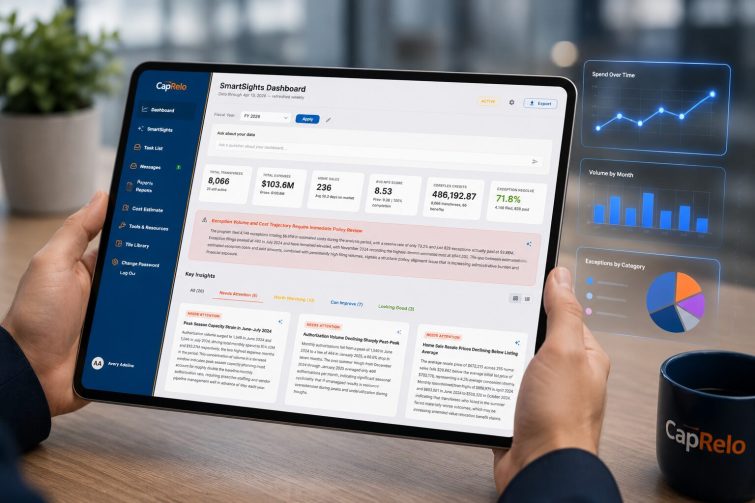
SmartSights is CapRelo’s AI-powered relocation analytics reporting tool, serving as an intelligence layer that transforms complex program data into clear, actionable insights. Its user-friendly dashboard provides real-time visibility into relocation expenses, exceptions, satisfaction trends, and move status.
Budget setting and tracking are already the #1 AI use case in corporate relocation (Atlas 2026 Survey). SmartSights takes this further by contextualizing cost data alongside exceptions, timelines, and satisfaction trends, so leaders aren’t just seeing numbers; they understand what those numbers mean so they can take action when and if needed.
How It Works: AI-Driven Intelligence Across Your Program
Companion’s SmartSights adds a trend-identification and “what this means” layer on top of real-time dashboards and move data:
Program Health at a Glance: A single, real-time dashboard brings volume, spend, and satisfaction into one coherent view, so leaders can see exactly how the program is tracking and where attention is needed.
Trend & Risk Detection: SmartSights monitors activity patterns and flags early signals (cost pressures, capacity constraints, sentiment shifts) so teams can intervene before issues escalate. Combined with satisfaction data and feedback trends, it surfaces sentiment patterns such as gradual declines in service quality or recurring friction at specific steps.
Plain-Language Insights: AI-generated narratives bridge the gap between raw numbers and decisions. Individual transferee files are synthesized into instant, plain-language summaries (timelines, costs, exceptions, milestones), while program-level trends are explained in terms of their implications for staffing, vendors, and planning. No more hours spent manually compiling status updates before executive briefings.
“Ask Anything” AI Assistant: Stakeholders query the program in everyday language: “Where are we seeing repeated exceptions?” “Which suppliers show the most delays?” “Which policies have the highest over-budget rates?” and get answers instantly.
Executive-Ready Views: SmartSights produces leadership-ready reporting without manual preparation, with stronger program clarity that executives can absorb at a glance.
The outcome is a program that becomes more intelligent as it evolves, where data not only informs decisions but drives them.
Insight That Moves the Needle
SmartSights surfaces trends and connects them to action, continuously monitors program activity and flags emerging patterns before they become entrenched problems, giving your team the intelligence to intervene early:
Policy alignment: When patterned exceptions or frequent off-policy approvals arise, SmartSights helps examine whether policy design is misaligned with market practice, internal needs, or employee expectations and surfaces options for recalibration.
Process and supplier performance: When systemic delays surface, the platform assesses process design and supplier delivery, recommending revised workflows, enhanced controls, or supplier changes.
Cost optimization: When spend trends emerge (e.g., rising costs in specific locations, benefits, or move types), SmartSights models alternative benefit designs, core-flex structures, or sourcing strategies to rebalance cost against experience.
Employee experience: Sentiment and feedback trends inform duty-of-care improvements: adding destination services, strengthening family support, or revisiting communication touchpoints to address friction before it compounds.
This is what an evolved mobility function looks like: one where intelligence is continuous, not quarterly. EY’s research confirms the payoff: organizations operating at this level of connectivity are 1.8 times more likely to significantly drive business growth.
Human-Centered by Design
SmartSights is built on a simple conviction: AI makes great people better. Our solutions empower consultants and account managers with faster pattern recognition, richer context, and earlier signals, so the human expertise you rely on is informed by intelligence that would be impossible to assemble manually.
Mobility leaders continue to work with experienced relocation professionals who provide judgment, counsel, and personalized support. They just do it with a sharper picture of what’s happening and what’s coming. Research confirms this is where AI delivers the greatest value: a collaborative, human-led model that combines efficiency with expert judgment.
At CapRelo, SmartSights is how we elevate your team and empower you to lead your program with technology built for relocation.

The Impact: As the provisions of the ROAD to Housing Act take shape, mobility professionals should be prepared to monitor how states and local governments adapt their zoning and permitting processes to align with the new federal framework. Over time, as more homes are built, relocating employees may face less competition in tight markets, potentially reducing temporary living costs and the need for exceptions to employee relocation policies. However, moderating home prices in overheated metros may increase loss-on-sale exposure for transferees selling there. Mobility teams should watch for shifts in appraisal practices, financing options for new property types, and opportunities to recalibrate cost-of-living adjustments and home-purchase assistance as market conditions evolve.


 How It Works: AI-Driven Intelligence Across Your Program


