Can Artificial Intelligence Improve Global Workforce Mobility?

Artificial intelligence is reshaping how industries operate, and global workforce mobility is no exception. Hardly a day passes without an AI headline, and relocation teams are right to ask what the technology really does for them.
As organizations look for smarter ways to manage employee relocation, AI has moved from novelty to a working tool. It can take routine tasks off a consultant’s plate, surface the data HR leaders have long wanted, and make the transferee’s experience feel more personal along the way. So is AI just another buzzword, or a real addition to your relocation management toolkit? Here are three ways it’s already making a difference.
The Evolution of Artificial Intelligence in Business and Global Mobility
While artificial intelligence may feel like a recent breakthrough, its roots in business innovation run deep, and its path into global mobility has been decades in the making. The idea of using technology to extend human capacity traces back to the 1950s, though interest in it ebbed and flowed for years. Successful use cases came and went until generative AI brought tools like ChatGPT into everyday use, and suddenly, AI was the technology every business felt it had to have.
But for what purpose? The rush to adopt AI looks a lot like what organizations faced when the internet began to spread in the mid-1990s. Back then, companies raced to put up a web page because it was the thing to do, not because they had worked out why. It was classic FOMO, a fear of being late to the party. AI has followed a similar arc.
How to Use Artificial Intelligence Strategically in Global Mobility Programs
Rather than adopting AI blindly or ignoring it altogether, global mobility organizations should look hard at where artificial intelligence creates real value in their relocation programs.
“We cannot afford to ignore AI any longer,” says Deloitte Associate Director Ross Markum. “We as global mobility professionals have an opportunity to master an extremely powerful tool that can deliver untold benefits to our global mobility function, our employees’ experience and even our careers.
“Neither burying our heads in the sand nor trying to crowbar AI into every aspect of our program are viable options,” Markum adds. “Rather, we should ask ourselves, how can I judiciously use AI to exploit my data, automate repetitive, low-value tasks and drive a world-class employee experience?”
We see three key ways artificial intelligence can improve global workforce mobility:
- Enhancing the transferee experience through personalized support and AI-driven recommendations
- Supporting HR leaders with real-time analytics and stronger decision-making tools
- Improving relocation efficiency by automating repetitive tasks and reducing manual workloads
Using AI to Enhance Transferee Experience
Relocating is stressful. In fact, it ranks among the three most stressful things an individual can experience. Our job as relocation management consultants is to make that experience as smooth, seamless, and pleasant as possible. The high-touch, single-point-of-care personal service of a relocation consultant can never be replaced by technology.
But AI can enhance that experience in ways only technology can. A chat feature in the transferee’s relocation portal, for instance, gives that employee the ability to access help from around the world, after hours or on weekends, on their own time frame. That said, chat features are only as good as the people staffing them after hours.
An AI-enabled virtual consultant or chatbot, trained to know as much as possible about the organization’s relocation policy and processes, can act as a valuable intermediary and an immediate source of answers. By curating information on each individual transferee, AI can be a game-changer in helping them navigate the complex relocation process.
The virtual assistant knows, for example, that transferee Michael has two elementary-age children who like to swim. While he’s en route to his new location, the AI proactively notifies him about swim classes near his new home and a program at their elementary school. Those recommendations live within the platform, so the experience feels organic and personal, much like how Netflix recommends content based on a subscriber’s past behavior.
How AI Supports HR Leaders in Global Mobility Management
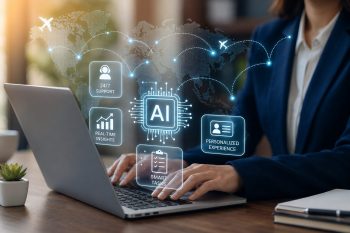
In global mobility management, artificial intelligence gives HR leaders real-time access to the kind of actionable data they’ve been asking about for years. Gartner projects that 75% of new analytics content will be contextualized for intelligent applications through generative AI by 2027, pointing to a near future in which pulling insights from mobility data no longer means writing a SQL query or waiting on a static report.
The HR manager simply types in a question, say, what are my year-over-year quarterly numbers for exceptions, and the virtual assistant maps the answer into an interactive dashboard. They get a live picture of everything tied to relocations, right down to the individual transferee.
Using AI to Improve Relocation Management Efficiency
In our experience, a transferee works with a relocation consultant for an average of 15 to 30 hours and asks 25 to 50 questions over the course of their move. If AI can absorb even a portion of those questions, it could translate to 6,600 hours saved for both the consultant and, most importantly, the transferee.
It also frees relocation consultants to focus on the more complex concerns a transferee brings to them. That means fewer phone calls for the transferee, saving them time and delivering better service. Beyond efficiency, AI can also support mobility sustainability by minimizing paper-based workflows, unnecessary travel, and energy-intensive processes, fostering a more eco-conscious approach to global relocation.
Megan Piccininni, who leads IBM’s Global Salesforce Service Transformation practice, put it this way in an Austin American-Statesman article: “AI might not be a panacea to poor customer service, but I believe it can be a powerful ally in an organization’s pursuit to create experiences that can help customers, foster loyalty, and drive growth.
“Freeing up human agents so they can pivot to more personalized customer engagements, where it matters most, is one of the most immediate ways organizations can offer enhanced value to customers, differentiate their brand, and begin transforming customer service from a cost center into a revenue accelerator.”
AI vs. Traditional Mobility Processes
The difference AI makes is easiest to see side by side with how relocation programs have traditionally run.
| Feature | Traditional Mobility | AI-Powered Mobility |
|---|---|---|
| Transferee support | Business hours, human-only | Human consultants plus 24/7 AI assistance |
| Data access | Static spreadsheets and reports | Real-time, interactive dashboards |
| Routine questions | Handled one by one by consultants | Triaged and answered instantly by AI |
| Personalization | Generic checklists | Recommendations tailored to each transferee |
Explore AI-Driven Global Mobility Solutions by CapRelo
At CapRelo, we use AI to enhance the speed, precision, and effectiveness of our human intelligence, all in service of a better transferee experience, more empowered HR leaders, and a more efficient program. Our AI-driven solutions help mobility teams work smarter and act as a virtual consultant for relocating employees, delivering high-touch care in a low-touch experience. Explore how we’re connecting without connecting by blending self-serve technology with human support to create next-level relocation experiences.
Learn more about our technology-driven, AI-supported relocation services or reach out if you have questions.
Frequently Asked Questions
What is global workforce mobility?
The practice of relocating employees across cities, countries, or regions to meet business needs. It also encompasses everything that supports those moves: immigration and compliance, housing, benefits, and the day-to-day care a transferee needs to settle in. For employers, it’s how talent gets to where the work is without the move itself becoming a barrier.
How is artificial intelligence used in global mobility?
AI shows up in three main places. It powers virtual assistants and chatbots that answer transferee questions around the clock, it turns relocation data into real-time dashboards for HR leaders, and it automates repetitive tasks so consultants can spend their time on the complex, human side of a move. Used well, it speeds up the routine work without displacing the relationships that make relocation feel manageable.
Can AI replace relocation consultants?
No. The high-touch, single-point-of-care relationship a consultant provides is the part technology can’t replicate. What AI does is take the predictable questions and the administrative load off the consultant’s plate so they can focus on the issues that genuinely need a person. Think of it as a capable assistant working alongside the consultant rather than a substitute for them.
What are the benefits of AI in employee relocation?
The clearest benefits are faster answers for transferees, better data for the HR teams running the program, and meaningful time savings on both sides. When AI handles a share of the routine questions, consultants get hours back, transferees wait less, and the program runs leaner. It can also support more sustainable moves by cutting paper-based workflows and unnecessary travel.
Insights + Resources
View all
AI Relocation Cost Forecasting and Policy Compliance: What AI Really Does for Mobility Teams in 2026

Flexible Relocation Benefits: A Smarter Approach for HR Leaders

Workforce Automation & Corporate Restructuring: Implications for Global Mobility
