September 2026 Insider: Rethinking Your Relocation Program, Assignee Wellbeing, and Global Mobility Radar

In Case You Missed It
Mobility continues to evolve alongside shifting market conditions and global trends. Catch up on our latest insights on non-traditional relocation benefits, global civil unrest, and finding cost savings in mobility programs.
- What Do Assignees Really Want: Top Non-Traditional Relocation Benefits in 2026
- Navigating Civil Unrest: Protecting Global Assignments and Employees
- Finding Cost Savings In Your Workforce Mobility Program
Spotlight Story
Quiet Months, Clearer Insights: Rethinking Your Relocation Program
For most of the relocation industry, late summer is the finish line. Search demand for movers consistently peaks in June and July before tapering off through the fall, tracking closely with the school calendar and the traditional peak relocation window. School is back in session, moving trucks are less booked, and the volume that defined the last few months has started to ease. For CapRelo, a global relocation and mobility management company, this marks the winding down of peak season.
For many of the HR and mobility teams we work with, this quieter stretch is the first real opportunity all year to step back from execution and look at the relocation program itself. Mercer, a global consulting firm that advises organizations on mobility program design and benchmarking, points to a simple but often overlooked reality: companies that do not proactively review their international assignment programs on a regular basis run the risk of policies drifting out of step with what the organization actually needs, and of expatriates ending up under-supported as a result. During peak season, that kind of review is nearly impossible to prioritize. Now, it is.
A useful program review does not require reinventing the policy from scratch. It starts with a few honest questions: is the current level of support still right for the organization’s hiring needs, where are exceptions happening most often and why, and is the process still simple for both HR teams and employees to navigate? Increasingly, clients do not have to answer those questions from memory or a stack of spreadsheets. SmartSights, CapRelo’s AI-powered program insights tool, surfaces the patterns directly, across relocation volumes, cycle times, costs, exceptions, and employee feedback, so the review starts from what the data actually shows. From there, prioritizing the changes with the biggest impact, whether that is improving visibility into relocation costs, reducing manual work, or updating benefits to better match what candidates now expect, tends to matter more than trying to fix everything at once.
CapRelo partners with clients on exactly this kind of review, whether that means benchmarking a policy against current practices, walking through where a flexible relocation benefits model like CompanionFlex could reduce friction, or simply talking through what is working and what is not before the next busy season builds back up. This is also where SmartSights becomes a natural part of the conversation. Instead of digging through spreadsheets, clients can ask a direct question, “where are our repeated exceptions happening” or “which suppliers are causing delays,” and get a plain-language answer pulled  straight from their own program data, with cost, cycle time, and feedback trends included.
The quiet months do not come around often. Used well, they are a chance to head into next year with a program that fits better, backed by clearer insight and a partner already at the table.
Feature Stories
Why a Six-Month Touchpoint Beats a Once-a-Year Check-In for Workforce Mobility
New research from Axa Global Healthcare’s World of Work research on assignee wellbeing surveyed nearly 1,300 HR decision-makers and assignees across 10 markets, and one finding stands out: assignees who sit down for a benefits check-in every six months report notably higher wellbeing than those who only hear from their employer once a year. The study also surfaced a real gap between what companies believe they are offering and what assignees say they are actually experiencing day to day, particularly around mental health support and support for accompanying family members.
The Impact: This is not about rewriting a policy; it is about checking in with the person living it. A quick, personal conversation twice a year, “how is the housing working out, is your family settling in, is anything harder than expected,” can surface a struggling assignee long before it becomes an early return. CapRelo encourages clients to build that regular human touchpoint into every assignment cadence, not just the paperwork milestones; the data suggests assignees who feel unseen between the start and end of their move are the ones most likely to disengage, regardless of how generous the benefits package looks on paper.
When Global Conflict Reshapes the Trip: What Travelers Are Telling Mobility Programs
Global Rescue’s latest Traveler Sentiment and Safety Survey found that 29% of experienced international travelers canceled, postponed, or changed a trip in 2026 because of destination safety concerns. Geopolitical risks now shape travel decisions broadly: 72% say civil unrest and security concerns influence where they go by at least a moderate amount, and only 8% say security plays no role at all. Among those who adjusted plans, most did not cancel outright; they picked a different destination or pushed the trip back, while 71% carried on as planned despite an increasingly uncertain global travel security landscape.
The Impact: This data emphasizes what mobility and travel teams are probably observing: international travel risks are now a constant factor in trip and assignment planning, not just occasional disruptions. CapRelo advises clients to treat instability as a stress test. Keep contact and emergency information current for every traveler and family member. Increase check-ins as risk rises. Confirm security provider agreements are active before a crisis hits. Document evacuation routes and alternative host locations in advance, and pre-arrange temporary housing rather than sourcing it under pressure. Building risk assessment into pre-travel approval, not just crisis response, reflects a stronger duty of care and gives employees more confidence before they book.
Global Radar
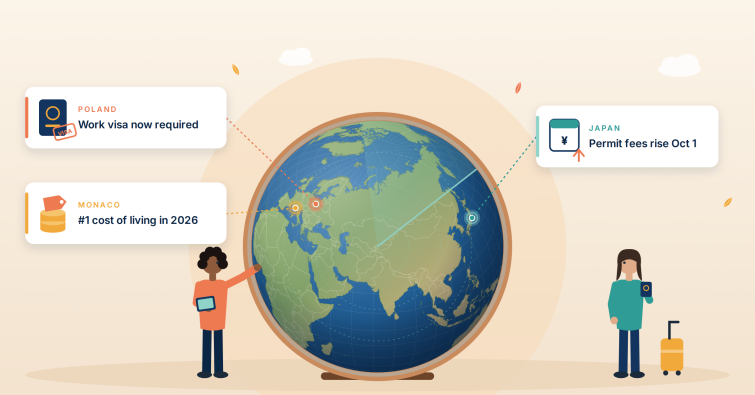 CapRelo’s Mobility Radar provides valuable insights into trends worth monitoring. This month, we have detected important global mobility updates in Monaco, Japan, and Poland.
- As of August 22, 2026, nationals of Colombia, Georgia, and Venezuela can no longer work in Poland under Poland’s new work visa requirement for certain nationalities; a work visa is now required before arrival for employment purposes. Clients with active or upcoming assignments involving talent from these three countries should reassess their status promptly.
- The 2026 global cost-of-living index has a new leader: Monaco, driven by constrained housing supply and a persistently international buyer base, with Hong Kong and Singapore close behind. The rankings use New York City as the benchmark and urge mobility teams to weigh purchasing power parity rather than headline salary when building assignment packages for these locations.
- Japan’s Cabinet approved Japan’s new immigration and residence permit fee increases effective October 1, 2026, including a twentyfold jump for permanent residence applications, from ¥10,000 to ¥200,000. Renewal fees move from a flat ¥6,000 to a tiered ¥10,000 to ¥75,000 depending on length of stay, and applications filed on or before September 30 lock in current rates.


