Intercultural Training for Employees: When Online Is Enough

A mobility leader has 40 international assignments to plan for next year and a training budget that won’t cover intensive coaching for all of them. One transferee is heading from Chicago to Toronto for six months, solo. Another is relocating with a partner and two school-age children to Riyadh for three years. Giving both the same intercultural training wastes money on the first and short-changes the second.
Intercultural training for employees isn’t a yes-or-no decision. It works best when it’s matched to the assignment. Self-paced online tools are enough for many short, low-complexity moves. Live training and coaching earn their cost when the assignment is long, the destination is unfamiliar, the role depends on local relationships, or a family is moving too. This guide gives HR mobility teams a practical framework for deciding which transferees get which level of support.
Key takeaways
- Online intercultural tools are usually enough for short, solo assignments to culturally familiar destinations where the role is mostly internal.
- Add live virtual training when the destination is less familiar, the role is client-facing, or the assignment runs longer than six months.
- Reserve in-person training or ongoing intercultural coaching for long assignments, high-stakes leadership roles, and families relocating together.
- Scoring four factors (assignment type, destination difficulty, family situation, and assignment length) gives HR a consistent, defensible way to allocate a limited budget.
- Only about one in three UK employers with overseas staff teach employees about cultural differences before departure, according to Everywhen research, so even a self-paced baseline puts many programs ahead.
What is intercultural training?
Intercultural training is structured preparation that helps employees and their families understand, adapt to, and work effectively within a culture different from their own. It covers communication styles, workplace norms, daily-life practicalities, and adjustment strategies, and it’s delivered through self-paced online courses, live virtual sessions, in-person workshops, or one-on-one intercultural coaching.
The terms intercultural training, cross-cultural training, and cultural training for expatriates are often used interchangeably. In global mobility, the four common formats are:
- Self-paced online tools: country guides, e-learning modules, cultural assessments, and short videos the transferee completes on their own schedule.
- Live virtual training: a scheduled session with a trainer, often a half-day, tailored to the destination and sometimes to the transferee’s role.
- In-person training: a one- or two-day program, usually before departure, with simulations, role-play, and time for family questions.
- Intercultural coaching: a series of one-on-one sessions that continues after arrival, built around real situations the transferee is facing.
Do expatriates need cultural training?
Most do, but not all need the same amount. The case for some preparation is strong. In Everywhen research reported by Relocate Magazine, 38% of UK employers with overseas staff said the main reason assignments fall short is that employees don’t settle in well. Yet the same research found that only 33% of those employers educate employees on cultural differences before departure.
Transferees notice the gap. A 2025 Crown World Mobility report, covered by HR Review, found that 37% of relocated employees received no cultural training at all, and 23% said their partner needed more help settling in.
The real question for most mobility programs isn’t whether to offer intercultural training. It’s how much each transferee needs, and in what format.
When is online intercultural training enough?
Self-paced online training is usually enough when most of these conditions are true:
- The assignment is short, typically under six months, or it’s a business-traveler or commuter arrangement.
- The employee is relocating alone.
- The destination shares a language and broadly similar workplace norms with the employee’s home country.
- The role is mostly internal, working with a team that already understands the employee’s home culture.
- The employee has lived or worked in the region before.
In these cases, a good online platform covers what the transferee needs: workplace etiquette, communication norms, practical daily-life information, and a reference to come back to after arrival. Adding live training for every move like this spends budget that would do more good elsewhere.
Online-only training starts to fall short when the transferee needs to practice, not just know. Reading that a culture values indirect feedback is different from leading a performance conversation with a local team. When the role depends on that kind of skill, or when a family is adjusting alongside the employee, live support is worth the investment.
A decision framework for intercultural training
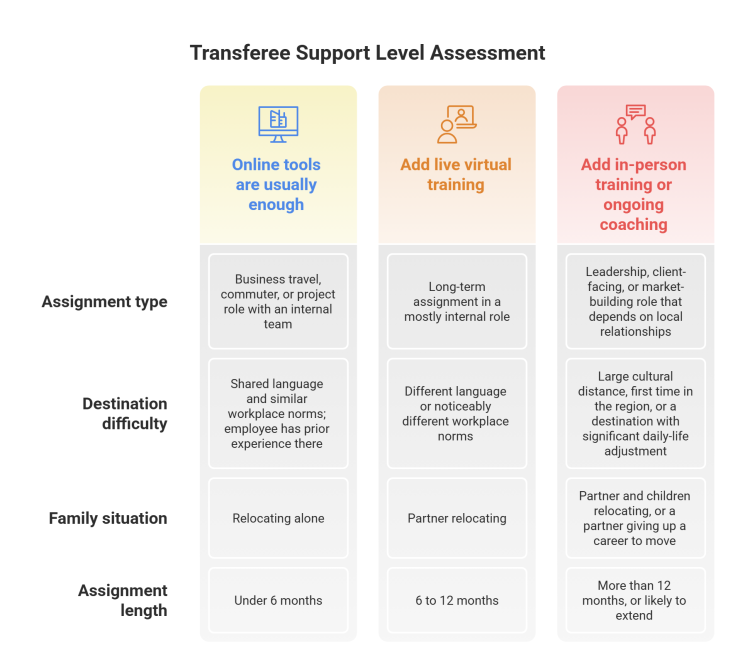
Score each transferee on four factors. The column where most of their answers land points to the right level of support.
How to turn the scores into a training tier
- Tier 1, self-paced: all four factors fall in the first column. Provide an online platform with destination content and a cultural self-assessment.
- Tier 2, blended: one or two factors fall in the second or third column. Add a live virtual session tailored to the destination, plus the online platform for reference.
- Tier 3, intensive: three or more factors fall in the second or third column, or any leadership role in a high-difficulty destination. Add pre-departure in-person training or live sessions for the whole household, followed by intercultural coaching during the first months on assignment.
Destination difficulty depends on where the employee is coming from, not just where they’re going. A move from the U.S. to Canada is low-difficulty for most U.S. employees. The same employee heading to Japan, Brazil, or Saudi Arabia for the first time faces more adjustment, both at work and at home. Score the move, not the country.
Three examples
- Six-month solo project in Toronto (Tier 1): short assignment, familiar destination, internal role, no family. Online tools cover it.
- Two-year engineering assignment in Germany with a partner (Tier 2): long assignment and a partner relocating, but an internal role in a destination the employee knows. A live virtual session for both partners, plus online resources, fits.
- Three-year country manager role in Riyadh with a partner and two children (Tier 3): leadership role, first time in the region, a full household relocating, and a long assignment. Pre-departure training for the whole family and ongoing coaching after arrival are worth the investment.
What is included in pre-departure cultural training?
A strong pre-departure cultural training program usually covers:
- Workplace culture: communication styles, decision-making, hierarchy, meetings, and feedback norms.
- Daily life: housing, banking, transportation, healthcare, shopping, and local etiquette.
- Family adjustment: schooling, partner networks, children’s transition, and what to expect in the first months.
- Adjustment strategies: recognizing culture shock and practical ways to manage it.
- Language basics: often handled through separate language training, coordinated with the cultural program.
Online tools handle the first two well. Family adjustment and real-world skill-building are where live training adds the most.
How long does cross-cultural training take?
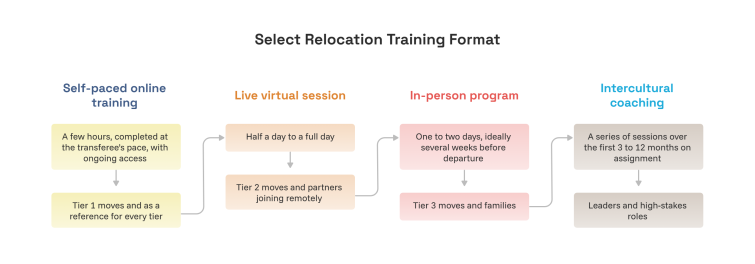
Timing matters as much as length. Training too early is forgotten; training too late competes with packing and paperwork. For live programs, a few weeks before departure tends to work best, with coaching picking up after arrival when real questions start.
How much does intercultural training for employees cost?
Costs scale with format. Self-paced platforms are typically priced per user and are the least expensive option. Live virtual sessions cost less than in-person days. One provider’s published guide puts country-specific preparation at roughly $2,000 to $6,000 for one to two days, and executive coaching programs at $10,000 or more. Pricing varies widely by provider, destination, and whether the family is included, so treat any range as a starting point for budgeting rather than a quote.
That spread is the reason a tiered approach matters. Moving even a handful of Tier 1 transferees from in-person training to online tools can free up budget for the families and leaders who need more.
How can HR measure whether intercultural training worked?
- Early-assignment check-ins: ask transferees and partners at 30, 90, and 180 days how settled they feel.
- Exception and early-return patterns: track whether certain destinations or tiers generate more requests or early returns.
- Time to productivity: compare manager feedback on ramp-up across tiers.
- Completion and usage: confirm online tools are actually being used, not just assigned.
Reviewing these signals once a year lets you adjust the framework. If Tier 1 moves to a particular destination keep struggling, that destination probably belongs in a higher tier.
How CapRelo builds cultural preparation into the relocation
At CapRelo, cultural preparation isn’t a standalone course. It’s part of the full transferee experience. For international assignments, our consultants start with pre-decision counseling and information trips, then coordinate language and cultural training, school placement, immigration support, and settling-in services at the host location. That means the level of intercultural training can be matched to each transferee’s assignment, destination, and family, and adjusted as the assignment unfolds.
Planning 2027 assignments on a fixed budget? Talk with our mobility team about building a tiered approach to intercultural training for your program.
Frequently asked questions about intercultural training
What is intercultural training for relocating employees?
Intercultural training for relocating employees is structured preparation that helps transferees and their families adapt to a new culture. It covers workplace communication, daily life, family adjustment, and culture shock, and it can be delivered through self-paced online tools, live virtual sessions, in-person workshops, or one-on-one coaching.
Can online intercultural training replace in-person training?
For short, solo assignments to culturally familiar destinations, online intercultural training is often enough. It falls short when transferees need to practice skills, such as leading a local team or negotiating with clients, or when a partner and children are adjusting too. In those cases, live virtual or in-person training adds value.
How long does cross-cultural training take?
Self-paced online training takes a few hours. Live virtual sessions typically run half a day to a full day, and in-person programs usually run one to two days before departure. Intercultural coaching continues over the first 3 to 12 months of an assignment.
What is included in pre-departure cultural training?
Pre-departure cultural training usually covers workplace culture and communication, daily-life practicalities, family and children’s adjustment, culture shock strategies, and language basics. The best programs tailor content to the destination and include the transferee’s partner.
When should companies invest in intercultural coaching instead of online training?
Intercultural coaching is worth the investment for long assignments, leadership or client-facing roles that depend on local relationships, destinations with large cultural distance from the employee’s home country, and families relocating together. Scoring each move on assignment type, destination difficulty, family situation, and assignment length helps HR decide.
How much does intercultural training cost?
Self-paced online platforms are the least expensive option and are usually priced per user. Country-specific live programs typically cost a few thousand dollars, and multi-session executive coaching can exceed $10,000. Costs vary by provider, destination, and whether the family is included.
Insights + Resources
View all
Lessons From Nine Relocations: What HR Leaders Should Know About the Transferee Experience

Relocating Employees to Japan: A Global Mobility Guide for HR

Hispanic Heritage Month: Building a More Inclusive Global Mobility Program
