Global Mobility in 2026: Navigating a Turning Point

-
AI Agentic Shift: 2026 marks the transition from “AI as a tool” to “Agentic Mobility”, where AI agents manage end-to-end logistics and predictive compliance.
-
Geopolitical Resilience: Mobility strategy is now a branch of risk management, navigating trade-driven manufacturing shifts and digital border enforcement.
-
The Housing Constraint: Talent mobility is no longer limited by policy, but by physical housing availability, forcing companies to offer “settling-in” asset support.
How is Global Mobility Changing in 2026?
The “new normal” has been replaced by a state of continuous reconfiguration. In 2026, the success of a mobility program is measured by its agility—how quickly it can pivot talent in response to new trade tariffs, semiconductor supply chain shifts, or AI-driven workforce restructuring.
1. AI and the “Human-Agent” Synergy
By 2026, AI has moved beyond simple administrative automation.
-
Predictive Workforce Planning: AI is now used to forecast talent shortages before they crystallize, particularly in regulated technical and engineering roles.
-
Agentic Logistics: 20% of organizations are using AI to flatten management structures, allowing mobility teams to shift from “process owners” to strategic value creators.
-
Digital Border Systems: Governments have fully implemented digital authorization systems (like Europe’s EES). Mobility teams must now treat data accuracy as a front-line risk, as e-gates and automated logs make compliance visibility absolute.
2. Geopolitical and Market Resilience
The 2025-2026 period has seen a massive reconfiguration of global trade corridors.
-
Manufacturing Hub Shifts: As advanced manufacturing reorients away from geopolitically distant partners, we see a surge in relocation demand toward hubs in India and Mexico.
-
The “Flight to Quality”: In commercial mobility, companies are trading large, underutilized floor plates for smaller, purpose-built spaces designed for hybrid collaboration.
-
Strategic Diversification: Organizations are diversifying away from traditional hubs toward “Safe Countries” (e.g., Iceland, Costa Rica) to ensure duty-of-care in an era of global unrest.
3. The Housing Crisis as a Mobility Barrier
In 2026, the biggest threat to a successful relocation isn’t the budget—it’s inventory.
-
Binding Constraints: Housing availability is now a “binding constraint” on labor mobility. Even with visa approval, workers cannot relocate if they cannot find a home.
-
Relocation Policy Evolution: Top-tier companies are now including home-buying assistance and extended temporary housing as core benefits to remain competitive in a stalled real estate market.
4. Sustainability and “Green Mobility” Mandates
Sustainability has transitioned from a PR goal to a mandatory RFP requirement.
-
Net-Zero Logistics: 61% of corporations now require green moving solutions, favoring partners with electric fleets and zero-waste packaging.
-
Digital Documentation: The elimination of physical paper trails is the new standard for global compliance and environmental reporting.
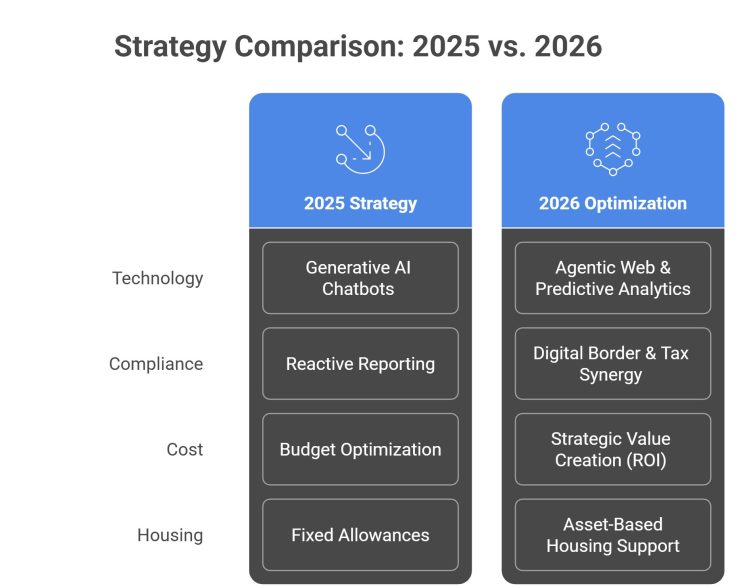
As we look toward 2027, the focus for global mobility leaders must be on bridging the gap between tax, finance, and HR teams. By treating mobility data as a strategic asset rather than an operational byproduct, organizations can turn talent movement into a sustainable competitive advantage.
Global Mobility 2026: Frequently Asked Questions
What are the top global mobility trends for 2026?
The 2026 landscape is defined by Agentic AI, where AI agents move beyond administrative tasks to handle predictive workforce planning and automated compliance. Other critical trends include a shift toward geopolitical resilience in supply chains and the rise of housing-centric relocation policies to combat global inventory shortages.
How is AI being used in employee relocation this year?
By 2026, leading relocation management companies like CapRelo are using AI for predictive analytics. This allows HR leaders to forecast assignment costs, identify potential geopolitical unrest before it occurs, and automate complex tasks like tax equalization and expense auditing with higher precision than manual methods.
What are the biggest compliance risks for global mobility in 2026?
Compliance is now a front-line risk due to digital border systems like Europe’s EES that provide governments with real-time visibility into traveler history. Additionally, the EU AI Act now requires full transparency and human oversight for any automated decision-making in HR and recruitment processes.
How are rising housing costs impacting mobility programs?
With 2026 seeing record-high mortgage rates and limited inventory, standard relocation packages are failing. Successful organizations are moving toward flexible benefit models, including managed cap and core/flex policies, to help employees navigate the prohibitive costs of short- and long-term accommodations.
Why is sustainability mandatory for 2026 relocation RFPs?
Sustainability has shifted from a nice-to-have to a core requirement. Modern RFPs demand Net-Zero Logistics, focusing on zero-emission transportation fleets, the elimination of landfill waste from packing materials, and fully digital documentation to meet corporate ESG goals.
What is Modular Mobility in the hybrid work era?
Modular Mobility is a strategy that treats international assignments as a continuum. Instead of only traditional long-term moves, 2026 policies facilitate a mix of digital nomad visas, short-term project-based rotations, and commuter assignments to align with the needs of a distributed, hybrid workforce.


