Why the UK Is Still a Top-3 Destination for Global Talent in 2026

Ask ten HR mobility leaders which country gave them the most headaches this year, and the United Kingdom will be on most of their lists. Ask them which country they can’t afford to stop sending people to, and it’ll be on those lists too. That tension — indispensable and complicated at the same time is the whole story of the UK in 2026.
The UK remains one of the top three destinations for globally mobile professionals, alongside the United States and, depending on the index you read, the UAE. For a company building a global footprint, that isn’t a surprise. What has changed is the cost and the compliance weight of getting an employee there. This post is the strategic overview — the landscape your program is operating in — before the following three posts go deep on the visa, the budget, and the human experience.
Why is the UK still a top destination for global talent in 2026?
The UK is a top-3 destination for global talent in 2026 because it combines a deep professional services and technology economy, a globally recognized higher-education pipeline, and a work-visa route — the Skilled Worker visa — that, for all its recent tightening, remains one of the more navigable in Europe for employer-sponsored talent. Demand is concentrated in technology, healthcare, engineering, and finance.
The pull is real and measurable. Applications from India, in particular, have surged — one driver behind the UK’s continued ranking near the top of global talent-flow maps. London holds its position as a finance and professional-services capital, and regional hubs like Manchester, Edinburgh, and Cambridge have become genuine draws for tech and life-sciences talent rather than afterthoughts.
Key stat: The UK sits in the global top three for permanent, employer-driven talent inflows in 2026 — a position it has held despite post-Brexit friction and rising sponsorship costs.
What changed for employers in 2024–2026?
Three shifts matter most to your program.
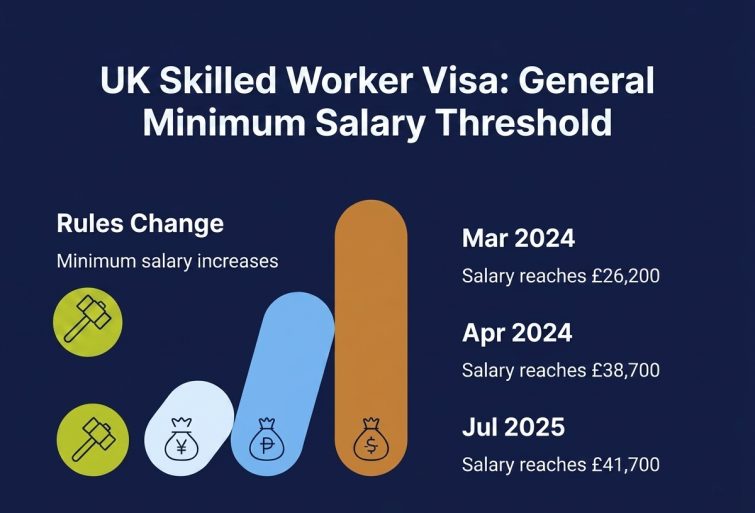
First, cost went up sharply. The general Skilled Worker salary threshold rose to £41,700 a year — up from £38,700, which itself replaced the old £26,200 floor. For senior roles where the occupation “going rate” runs higher, the real floor is higher still. Post 3 puts hard numbers on what that does to an assignment budget.
Second, the rules got more complex, not just more expensive. The Home Office no longer applies a single minimum. A sponsored salary now has to clear whichever is highest of the general threshold, the occupation-specific going rate, and an hourly-rate floor — and the 2025 immigration reforms added further conditions around settlement and skill levels. This is where sponsors get tripped up, and it’s the subject of Post 2.
Third, the talent itself shifted. The growth isn’t evenly distributed across the globe; it’s concentrated in specific corridors (India to the UK chief among them) and specific sectors. That has real implications for how you source, time, and support moves.
What does this mean for your mobility program?
It means the UK has quietly become a program where the difference between a smooth assignment and an expensive failure is almost entirely upfront planning. The countries that are easy to move to forgive a rushed process. The UK, in 2026, does not.
This is exactly the kind of multi-jurisdictional complexity CapRelo was built for. As a relocation management company (RMC) with 25+ years of global mobility experience and coverage across the Americas, EMEA, and Asia Pacific, CapRelo manages the compliance, cost, and care layers of a UK assignment as one connected program — not three disconnected vendors your HR team has to reconcile. The local supplier network, immigration coordination, and destination support are already in place; your team gets a single point of contact instead of a spreadsheet of them.
2026 Best Practice: Treat a UK assignment as a 4–6 month lead-time project, not a 4–6 week one. The visa timeline, the salary-threshold math, and housing in a tight rental market all reward companies that start early — and punish the ones that don’t.
Where this series goes next
Over the next three posts, we’ll move from landscape to playbook:
Post 2 — The Skilled Worker visa: thresholds, sponsor licences, timelines, and the mistakes that cause refusals.
Post 3 — The real cost: what a UK assignment actually costs once you go past the salary line.
Post 4 — The transferee experience: housing, schools, family, and the human factors that decide whether your investment stays.
The UK isn’t getting simpler. But a well-run UK program is one of the clearest signals to your best talent that the company is serious about their growth — and that’s worth getting right.
Planning UK or wider EMEA assignments this year? See how CapRelo manages global mobility as one connected program → Global Mobility Management
Insights + Resources
View all
It’s Not About the Move — It’s About the Experience: What the 2026 Relocation Survey Reveals

Outbound Is the New Inbound: How U.S. Visa Uncertainty Is Reshaping Global Talent Mobility

August 2026 Insider: Pet Relocation, World Cup Housing Disruption, and Off-Peak Move Timing
