What Is a Relocation Package? Costs, Components, and 2026 Benchmarks

A relocation package is the set of benefits and financial support a company provides to help an employee move for a new role. Whether you’re a new hire relocating across the country or a transferred employee moving internationally, the structure of a relocation package determines how much support you receive – and how much your employer spends.
Employee relocation continues to play a critical role in talent strategy even as companies navigate tighter budgets, evolving workforce expectations, and more flexible work models. In many organizations, senior leaders receive a more comprehensive executive relocation package to ensure their transition is smooth and aligned with the company’s broader mobility strategy.
Below, we break down updates costs ranges, what most employee relocation packages include today, and the key factors HR and mobility leaders use to build competitive programs.
What is a Relocation Package?
A relocation package is an employer-funded benefit that offsets the costs of moving for work. It may cover some or all of the services commonly included in relocation assistance, including transporting household goods, temporary housing, home sale and purchase assistance, travel expenses, and tax gross-up payments. Packages are structured in one of three ways: as a lump-sum payment the employee manages independently, as a fully managed program coordinated by a relocation management company (RMC) like CapRelo, or as a core-flex program — such as CompanionFlex — where a set of core benefits is combined with employee-selected optional services.
Not every relocation package looks the same. Organizations typically tier benefits based on employee level, homeowner vs. renter status, and the distance and complexity of the move.
What Does a Relocation Package Include?
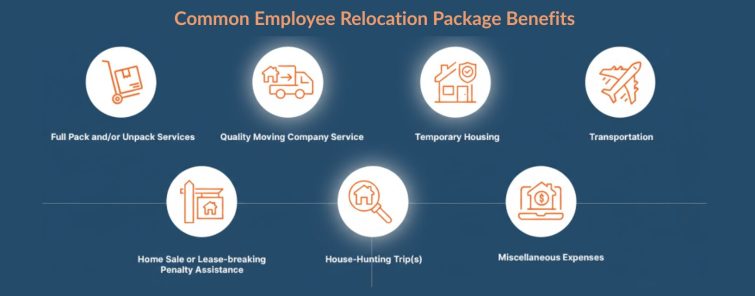
Most corporate relocation packages include a combination of the following services, though exact coverage depends on company policy and employee tier. For a step-by-step framework, see our guide to designing a comprehensive relocation package:
- Household goods moving — packing, transport, unpacking, and storage in transit
- Temporary housing — furnished corporate housing or hotel allowance, typically 30–90 days
- Home sale assistance — buyer value option (BVO), appraised value offer, or direct reimbursement of selling costs
- Home purchase assistance — mortgage assistance, house-hunting trip, closing cost reimbursement
- Travel expenses — final-move travel for employee and family, pre-move house-hunting trips
- Destination services — area orientation, school search, lease-breaking assistance
- Spousal/partner career assistance — job search support for relocating spouses
- Tax gross-up — additional payment to cover the employee’s tax liability on taxable relocation benefits
- Relocation allowance or lump sum — a fixed cash amount instead of or in addition to managed services
- Pet and vehicle shipment — where applicable
Relocation Package Cost Ranges by Employee Level (2026)
Below, we break down updated cost ranges, what most relocation packages include today, and the key factors influencing relocation budgets — so HR and mobility leaders can plan with confidence.
Relocation Package Cost Ranges by Employee Level (2026)
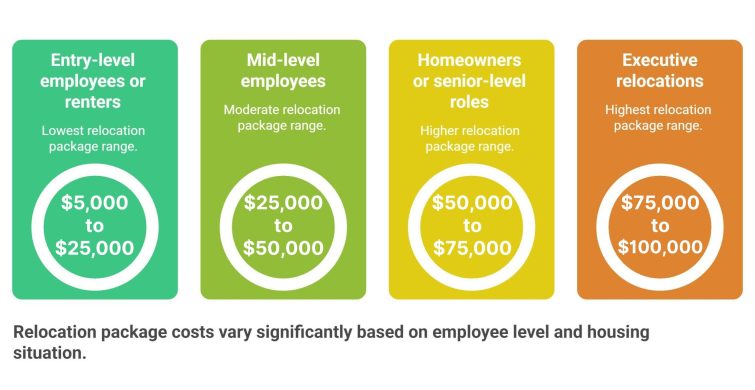 These ranges typically include a combination of moving services, housing support, and travel-related expenses. International relocations or complex homeowner moves may exceed these averages.
Need help designing a relocation package program? CapRelo works with HR and mobility teams to build packages that fit your budget, your policy, and your employees. We handle everything — from lump sum management to full-service coordination across 160+ countries. Talk to a CapRelo Consultant →
What Is a Good Relocation Package?
A competitive relocation package in 2026 covers the essential costs of a move and scales benefit depth to the employee’s level and housing situation. For mid-level professionals, a package in the $15,000–$35,000 range with managed moving services and temporary housing is generally considered strong. For executives, $55,000–$90,000+ with full home sale assistance and family support sets the benchmark.
The quality of support — coordination, communication, and consultant access — often matters as much as the dollar amount. Employees who feel guided through the process report higher satisfaction and are more likely to settle into their new role quickly.
Lump Sum vs. Managed vs. Core-Flex: How Relocation Package Types Compare
| Package Type | How It Works | Best For |
| Lump sum | Fixed cash paid directly to employee. Employee manages own move. | Entry-level, renters, low-complexity moves |
| Managed / full-service | RMC coordinates all services. Employer pays vendors directly. | Homeowners, senior hires, complex or international moves |
| Core-flex (CompanionFlex) | Core benefits guaranteed + employee selects from a menu of optional services within a budget. | Mid-level and above; balances employee choice with cost control |
CapRelo offers all three structures. CompanionFlex — our core-flex platform — is designed for companies that want to give employees meaningful choice without sacrificing program control. See how CompanionFlex works →
Building or benchmarking your own program?
Every organization’s relocation needs are different. Our step-by-step guide walks HR and mobility teams through tiering benefits, controlling costs, and creating a policy that attracts and retains top talent.
Read the Guide to Designing a Comprehensive Relocation Package →
Key Factors That Affect Relocation Package Cost
Several factors influence the total cost of an employee relocation:
- Distance of the move: Local, cross-country, or international
- Housing market conditions: High-cost markets increase temporary housing and home sale expenses
- Homeownership: Selling and purchasing a home significantly raises costs
- Family size: Dependents increase travel, housing, and support needs
- Policy design: Lump-sum vs. managed benefits
Understanding these variables helps organizations build relocation programs that are both competitive and cost-controlled.
Relocation Costs by Employee Type
Understanding how relocation needs differ by employee type helps align benefits with business objectives:
- Renters: Typically require fewer services and lower overall costs
- Homeowners: Incur higher expenses due to home sale, closing costs, and housing market risk
- Single employees: Generally less complex than family relocations
- Employees with families: Require additional housing, education, and support services
This segmentation allows companies to design fair, scalable relocation programs.
Frequently Asked Questions
What is a typical relocation package amount?
In 2026, typical U.S. domestic packages range from $5,000–$15,000 for entry-level renters to $55,000–$90,000+ for executive homeowners. The most common mid-level package falls between $15,000 and $35,000.
Are relocation packages taxable in 2026?
Yes. Under current U.S. tax law (post-2017 Tax Cuts and Jobs Act), most employer-provided relocation benefits are considered taxable income for the employee. This means both the employee and employer pay payroll taxes on relocation payments. Many companies offer a gross-up—an additional payment to cover the employee’s tax liability—to avoid benefit erosion. Consult a tax professional for your specific situation.
Can employees negotiate a relocation package?
In many cases, yes—especially for hard-to-fill roles, senior positions, or moves from high cost-of-living areas. Negotiation is most successful when focused on specific, quantifiable needs: home sale timing, temporary housing duration, or lump-sum flexibility. Candidates are most likely to succeed when they come prepared with real cost data rather than a round-number request.
What is a lump-sum relocation package?
A lump-sum relocation package is a fixed cash amount given to the employee to spend on their move as they see fit. It reduces administrative overhead for employers and gives employees flexibility. However, without clear guidance or a minimum spend threshold, employees may underspend on important services—leading to a stressful move and lower satisfaction. Lump sums work best when paired with preferred vendor access and spending recommendations.
How much does it cost to relocate an employee internationally?
International relocations average 2–3× the cost of comparable U.S. domestic moves. A mid-level professional relocating internationally can expect total package costs in the $40,000–$90,000+ range, depending on the destination country, housing market, visa complexity, and family size. Additional costs include immigration and visa support, cultural and language training, school search, and ongoing cost-of-living adjustments.


