The Importance of Data Security in Global Mobility

Getting to Data Excellence in Global Mobility
Data security in global mobility has become a critical concern as companies manage sensitive employee information across borders. Recent cyberattacks, like the Fast Company breach, highlight how quickly organizations can lose trust, data, and business continuity. As global mobility programs expand, protecting employee data isn’t optional. It’s essential.
Why Data Security Risks Are Increasing in Global Mobility
Remote and hybrid work have become a permanent baseline, not a temporary workaround. According to Gallup, more than half of U.S. employees work in hybrid environments—another 27% working fully remote. That’s a structurally expanded attack surface, and cybercriminals have adapted right along with it.
The device’s boundary is one of its biggest vulnerabilities. When employees switch between corporate systems, personal apps, and home or public networks, the risks multiply. For relocating employees, those risks are compounded: new networks, unfamiliar environments, and disrupted routines all make it harder to maintain a strong security position.
Global mobility programs face multiple data security risks, including:
- Phishing attacks that target employees in transit or working across unfamiliar networks
- Shared and personal device use that blurs corporate security boundaries
- Unauthorized access to sensitive employee and immigration data
- Increased exposure from unsecured home or public Wi-Fi connections
BM’s 2024 Cost of a Data Breach Report reveals that the average breach cost reached $4.88 million, a 10% spike and the highest year-over-year increase since the pandemic. Legal fees, regulatory fines, and customer remediation are just the beginning. Throw in brand damage and hurt employee trust, and the argument for carefully vetting your global mobility partner’s security posture becomes ironclad.
Before you engage a global mobility partner, it’s worth pressing them on a few critical questions:
Are You GDPR Compliant in Global Mobility Data Security?
In 2018 the General Data Protection Regulation (GDPR) established strict rules for how organizations handle personal data in the EU. As cyber threats have escalated, GDPR has become a global benchmark for data security compliance, with other regions increasingly modeling their own frameworks around it. Non-compliance carries significant regulatory fines and real reputational risk.
Companies managing global mobility programs must ensure that both their internal systems and all external partners they work with are fully GDPR-compliant. For us at CapRelo, GDPR compliance is the starting point, not the ceiling, of our data security protocols.
Does Your Company Hold an ISO 27001 Security Certification?
ISO 27001 is perhaps the gold-standard framework for managing IT security, confirming that a company has the systems in place to protect its data. Compliance signals a secure, reliable organization that clients can trust with sensitive information.
Earning ISO 27001 certification is no small task. An applicant must audit for risks and gaps in their IT security, develop and implement a risk management plan, train employees, and pass a rigorous two-part external audit. Ongoing internal audits are required to maintain it. CapRelo’s data security framework is built on ISO 27001, NIST SP 800, and GDPR compliance, and we continue to meet these requirements year after year.
Third-Party Security Audits are Critical for Global Mobility Data Security
 A third-party IT audit takes a hard look at your IT environment, from cybersecurity vulnerabilities to risks embedded in your vendor platforms and service providers. In our work supporting multinational relocations, we’ve seen data exposure risks increase significantly when organizations assume vendor partners share the same security standards without verifying it. A single unaudited provider in your supply chain can create meaningful gaps.
That’s why third-party security audits are a routine part of CapRelo’s IT system management, and why earning and retaining our clients’ trust is central to everything we do. A comprehensive audit evaluates:
- System vulnerabilities and cybersecurity gaps
- Data handling, storage, and access control practices
- Risks from external vendors and technology platforms
- Compliance with global security standards, including ISO 27001 and GDPR
The following workflow illustrates the key layers organizations should implement to protect sensitive employee data throughout a global mobility program.
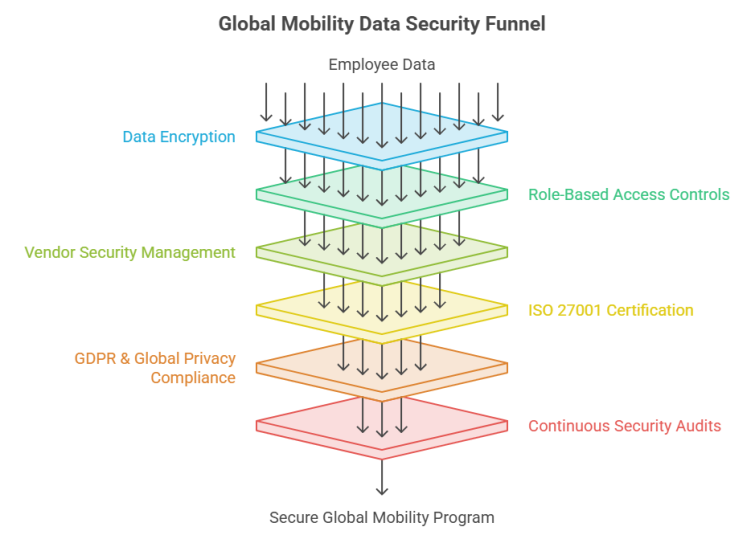
How Data Redundancy Protects Global Mobility Data Security
Data redundancy is a critical component of global mobility data security. It ensures that sensitive employee and corporate data lives in multiple secure locations, reducing the risk of total loss from a cyberattack or system failure. CapRelo maintains full data redundancy across geographically diverse, secure co-located data centers, protecting your program against outages that can otherwise result in lost time, financial penalties, and lasting reputational damage.
How CapRelo Ensures Data Security in Global Mobility Programs
Maintaining strong data security in global mobility requires a proactive approach that crosses compliance, certification, third-party auditing, and redundancy. Organizations that build these elements in protect not just their data but also their reputation and their employees’ trust.
CapRelo encrypts all client communications using TLS and AES protocols. Our role-based security architecture ensures sensitive data is accessible only to authorized individuals, and our standards are audited against best-practice benchmarks as new threats evolve.
Partner with a global mobility provider that prioritizes data security at every level. Contact CapRelo to learn how our security framework protects your employees and your program.
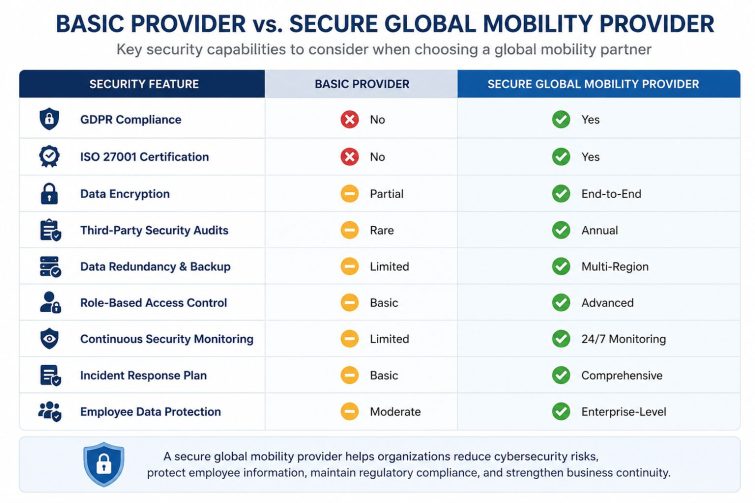
Not all global mobility providers offer the same level of data protection. The comparison below highlig
Frequently Asked Questions (FAQ)s
What is data security in global mobility?
The processes, compliance frameworks, and technologies that companies use to protect sensitive employee and corporate information. This applies during relocations and cross-border assignments, including encrypted data transfer, GDPR compliance, third-party audits, and access controls.
Why is GDPR important for global mobility?
GDPR governs how organizations collect, store, and process personal data belonging to EU residents. Any relocation of employees to or within the EU triggers GDPR obligations for both the company and its third-party providers. Non-compliance can lead to significant fines and harm to a company’s reputation.
What is ISO 27001 certification?
ISO 27001 is an internationally-recognized certification framework for managing information security. Companies that earn it pass an external audit that confirms they have a formal system to identify risks, implement controls, and continually improve their security posture. For global mobility vendors, it’s one of the strongest indicators of a trustworthy, security-first partner.
How can companies reduce their data security risks in global mobility?
The best security-centric approach combines:
- GDPR compliance
- Periodic third-party security audits
- Role-based access controls
- ISO 27001-certified vendors
- Data redundancy across secure locations
Vetting every partner in your mobility supply chain matters just as much as securing your own systems.
Why is data redundancy important in global mobility?
Data redundancy ensures employee and corporate data isn’t lost in the event of a cyberattack or system failure. Maintaining copies across geographically diverse, secure locations enables organizations to recover quickly and maintain program continuity even during incidents.
Insights + Resources
View all
AI Relocation Cost Forecasting and Policy Compliance: What AI Really Does for Mobility Teams in 2026

Flexible Relocation Benefits: A Smarter Approach for HR Leaders

Workforce Automation & Corporate Restructuring: Implications for Global Mobility
