Optimizing the Mobility Supply Chain to Deliver Greater Client Value

Every successful employee relocation depends on a network of specialized service providers. Household goods moving companies, immigration firms, destination service providers, temporary housing companies, tax and payroll advisors, technology platforms, and other local specialists may all contribute to a single relocation.
Managing these providers as separate transactions can lead to inconsistent service, fragmented communication, limited cost visibility, and unnecessary administrative work. Effective supply chain optimization brings them together within a coordinated supplier ecosystem.
The objective is not simply to secure the lowest rate for each service. It is to control total mobility program costs while improving service quality, reducing risk, and delivering a consistent employee experience. For a broader look at how this fits into program design, see our global mobility program guide.
What Is Supply Chain Optimization in Global Mobility?
Supply chain optimization involves using supplier capabilities, performance data, governance processes, and technology to improve the efficiency and effectiveness of a supplier network.
In global mobility, this means making deliberate decisions about:
- Which relocation service providers to use
- How their services fit together
- How responsibilities are assigned
- How supplier performance is measured
- How the network will adapt as business needs change
This coordinated approach is increasingly important as the role of talent mobility expands beyond individual moves to include program management, supplier partnerships, workforce strategy, and the overall employee experience.
A lower rate does not always result in a lower total cost. Service delays, claims, avoidable policy exceptions, duplicated work, compliance failures, and poor communication can increase expenses while placing additional pressure on mobility teams and relocating employees.
A strong relocation supply chain management strategy therefore considers the total cost of ownership, not rates alone.
Supply Chain Optimization Strategies for Mobility Suppliers
1. Define Program and Supplier Requirements
Organizations should begin by evaluating relocation volume, common destinations, policy structure, service requirements, internal resources, and expected program growth.
This assessment establishes the supplier capabilities, geographic coverage, technology, compliance controls, and service capacity the program requires. It should also identify areas where consistency is especially important and where a specialized provider may add value.
Clear requirements create the foundation for a more effective supplier selection process.
2. Evaluate Total Value, Not Rates Alone
Pricing remains important, but it should be evaluated alongside:
- Service quality
- Responsiveness
- Financial stability
- Compliance and risk controls
- Geographic reach
- Technology capabilities
- Employee satisfaction
A provider that reduces avoidable exceptions, limits administrative work, communicates clearly, and resolves problems quickly may deliver more value than one offering the lowest initial rate.
This is the basis of effective supply chain cost optimization: reducing the full cost of service delivery rather than focusing only on individual fees.
3. Establish Clear SLAs and Performance Metrics
Service-level agreements and key performance indicators create accountability across the supplier ecosystem.
Useful vendor performance metrics may include:
- On-time service delivery
- Employee satisfaction
- Response and issue-resolution times
- Claims and exception rates
- Policy compliance
- Cost per relocation
- Compliance incidents or audit findings
- Service-level agreement attainment
Performance targets should reflect both financial objectives and the quality of the employee experience. They should also be specific enough to support meaningful comparison, performance benchmarking, and corrective action.
4. Review, Govern, and Improve Performance
Effective supplier relationship management continues after contracts are signed.
Regular performance reviews allow mobility and procurement teams to analyze results, address recurring problems, compare providers, and identify opportunities for innovation. Reviews should combine operating data with feedback from mobility teams and relocating employees.
A supplier may meet its technical requirements while still creating confusion or frustration during a relocation. Combining quantitative metrics with stakeholder feedback provides a more complete view of performance.
Strong supplier governance also helps organizations monitor financial stability, data security and cybersecurity supply chain risk, regulatory compliance, business continuity, and supplier capacity.
Supplier Consolidation or Specialization?
Supplier consolidation can simplify administration, reporting, contract negotiations, and vendor governance. It may also improve purchasing leverage and make it easier to maintain consistent service standards across locations.
However, specialized providers may offer deeper regional knowledge, greater flexibility, or expertise with complex relocation needs.
The most effective sourcing strategy is often a coordinated core network supplemented by specialized providers where they add meaningful value. The right balance depends on program size, geographic scope, employee populations, internal resources, and policy complexity.
A vetted preferred supplier network can improve consistency, accountability, cost visibility, and service coordination without eliminating access to specialist expertise.
How Relocation Management Companies Improve Supply Chain Performance
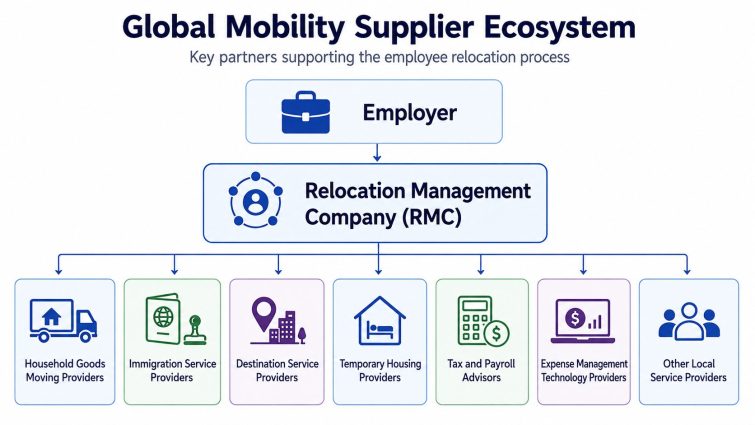
A relocation management company can centralize supplier selection, coordination, performance reporting, and issue resolution across the relocation lifecycle.
This gives employers greater visibility into service delivery and program costs while reducing the administrative burden on internal mobility teams. It can also support consistent standards across multiple suppliers, regions, and relocation types.
CapRelo maintains a vetted global mobility supplier network and provides move management oversight across supplier relationships to support service quality, cost efficiency, supplier accountability, and risk management. Through centralized oversight and ongoing performance management, the network supports both organizational priorities and the needs of relocating employees.
Ultimately, successful supply chain optimization is not about securing the lowest possible price for every service. It is about building a reliable supplier ecosystem that delivers measurable organizational value while supporting employees throughout the relocation process.


