All About Global Mobility: A Complete Guide for HR and Program Managers

Moving people across borders for work used to be a niche function tucked inside the HR dept. These days, it’s a competitive practice. Companies need to place the right person in the right city, on the right timeline, and with the right support. Doing so helps them win contracts, open markets, and grow leaders faster than companies that can’t.
This guide is for the HR and program managers already doing that work, or who are about to start. We’ll cover what global mobility actually involves, how programs are built, where they tend to come apart, and what the best ones do differently.
What Is Global Mobility?
Global mobility encompasses the set of policies, processes, and services a company uses to move employees across international borders for work. That definition covers everything from a two-week project trip to a permanent relocation. It also includes the immigration paperwork, tax planning, compensation design, and personal support that make those moves work. You’ll sometimes hear it called international assignment management. The term has stretched in recent years to include remote and hybrid arrangements that don’t fit the old expat mold.
Why Global Mobility Matters in Modern Organizations
A good program puts your best people where the business needs them. A bad one (or no program at all) costs you money and people. Without a structured program, assignments fail at higher rates, budgets balloon, and compliance issues tend to rear up six months after the fact, when they’re hardest to fix.
The companies that treat mobility as a strategic function, rather than a logistics problem, are the ones building genuinely global leadership benches and entering new markets without learning every lesson the hard way.
Types of Global Mobility Programs and International Assignments
Global Mobility Programs at a Glance
Organizations typically use four primary global mobility assignment types, each designed to support different business objectives, workforce needs, and assignment durations.
Long-Term Assignment
- Duration: 1–5 years
- Purpose: Business expansion
- Typical Employee: Leadership and key talent
Short-Term Assignment
- Duration: 3–12 months
- Purpose: Project support
- Typical Employee: Specialists and technical experts
International Transfer
- Duration: Permanent
- Purpose: Workforce relocation
- Typical Employee: Strategic talent
Remote Cross-Border Work
- Duration: Ongoing
- Purpose: Flexible workforce strategy
- Typical Employee: Remote employees
 Short-Term Assignments
These usually last three to twelve months. They’re useful for project work, knowledge transfer, or filling a gap until you can hire locally. Costs are lower than a long-term move, but your tax and immigration planning still have to stay on point. If you skip that step, you could accidentally trigger permanent establishment issues that hound the company for years.
Long-Term Assignments
Typically, these last one to five years. These are classic expat assignments, often tied to leadership development or sustained operational needs. The compensation package becomes more complicated; families usually come into the mix, and tax equalization becomes an ongoing exercise rather than a one-time calculation.
Permanent Transfers
Also called one-way moves. The employee and their family relocate indefinitely, and compensation shifts to local terms. It’s treated as a localization, not an expatriation, which changes almost everything about how you structure the move.
Remote and Hybrid Mobility
This is the category that has reshaped the field in the last few years. It covers work-from-anywhere policies, cross-border remote work, and employees splitting time between countries. These arrangements look flexible on the surface but create real compliance headaches underneath, especially around tax residency, social security, and local labor law. Most programs are still catching up.
Key Components of a Successful Global Mobility Program
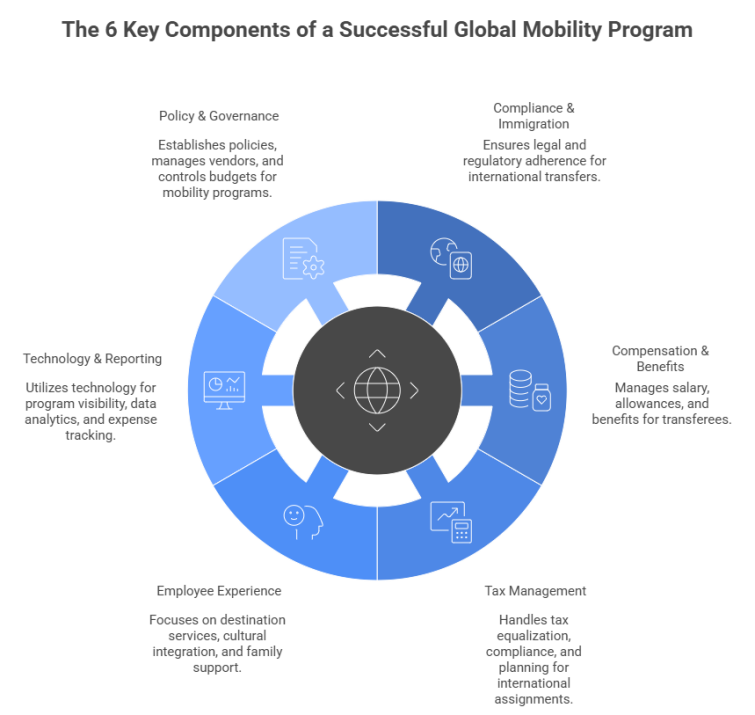
Compliance and Immigration
Most assignments rise or or fall on the immigration step. Since visa timelines vary wildly by country, the rules change often, and missing a requirement can delay an assignment by months. The strongest programs build immigration assessment into the front end of each move instead of treating it as a later task. CapRelo’s visa and immigration services help HR teams stay abreast of those requirements without putting business-critical assignments at risk.
Compensation and Benefits
A good program balances fairness, competitiveness, and company cost discipline. A typical international package includes:
- Base pay
- Cost-of-living adjustments
- Housing
- Hardship premiums
- Family benefits
- Schooling
Every line item is its own decision, and you must defend every decision to the employee and finance. Transparency around these packages protects both the experience and the budget, which is why most mature programs lean on dedicated global compensation services rather than handling it in-house.
Tax Considerations
Mistakes can swiftly become expensive when you deal with cross-border tax planning. The exposure typically includes:
- Home-country taxes
- Host-country taxes
- Social security payments
- Treaty positions
- Tax equalization
- Permanent establishment risk
Rather few companies have this expertise in-house, and the ones that try to wing it usually regret it. Dedicated tax support across the assignment lifecycle is worth the investment.
Employee Experience
The human side of the move includes:
- Pre-departure counseling
- Finding a place to live
- Getting kids into school
- Helping a partner figure out their own career
- Cultural training
- Someone to call when things go sideways
Programs that take this seriously and invest in real destination services have higher success rates and keep more people after the assignment ends. Programs that don’t lose talent they spent six figures relocating.
The Most Common Global Mobility Challenges for HR Teams
Regulatory Complexity
Unfortunately, immigration rules and tax treaties regularly change, often without much notice. If a country tightens work-permit eligibility, your candidate pipeline for that market suddenly shrinks. Programs lacking unified tracking and expertise quickly fall behind—leading to delayed assignments and compliance exposures that often resurface years later.
Consistent Cost Management
Relocation costs are hard to predict and it’s easy to lose the threads. The 2026 Atlas Corporate Relocation Survey found that economic conditions (53%), local talent shortages (27%), and the real estate market (26%) were the biggest external pressures on relocation in 2025.
The fastest-rising factor was newer: political and regulatory uncertainty climbed by 9 points after the U.S. imposed a $100,000 fee on new H-1B petitions.
Housing is its own snare. An employee who got a 3% mortgage near 2020 could face 7% on a move. That’s one element of the lock-in effect, and it has many people saying no before discussing anything else.
Pile on exception requests, currency volatility, and assignments that run six months overdue while nobody updates the system. It’s easy for programs to spend more than planned without realizing it.
Top Talent Retention
One result that frustrates HR leaders the most is when a company invests heavily in sending someone abroad. The assignment goes well; the employee returns, yet within two years they leave the company. Repatriation is another critical point where many programs fall apart. Career planning, mentorship, and a real conversation about what’s next have to start before the assignee gets on the plane home, not after.
Best Practices for Creating a Great Global Mobility Strategy
Understand Centralized vs. Decentralized Models
Centralized programs give you consistency, cost control, and a single source of truth. Decentralized programs offer local responsiveness but tend to drift over time; policies multiply and exceptions become the rule. Most mature organizations land on a hybrid of centralized governance with regional execution.
Use Technology and Automation
A worthy mobility platform takes the extra weight off your team’s shoulders. It can automate initiation, tracking, reporting, assignee communication, and expense management keep it all visible in real time. Platforms like our Companion client portal bring all of that into one place, and because they handle sensitive employee information across borders, data security in global mobility programs becomes a critical consideration. The technology frees your team to think strategically instead of chasing status updates.
Practice Policy Standardization
Have clear, multi-tiered policies. That will reduce exceptions and make your program easier to run. However, standardization doesn’t have to mean rigidity. Decide in advance what flexibility looks like, so that it’s a choice rather than a scramble. In a recent CapRelo program, a Fortune 500 client reduced relocation costs by 22% using centralized policy management.
How to Build a Global Mobility Program (Step-by-Step)
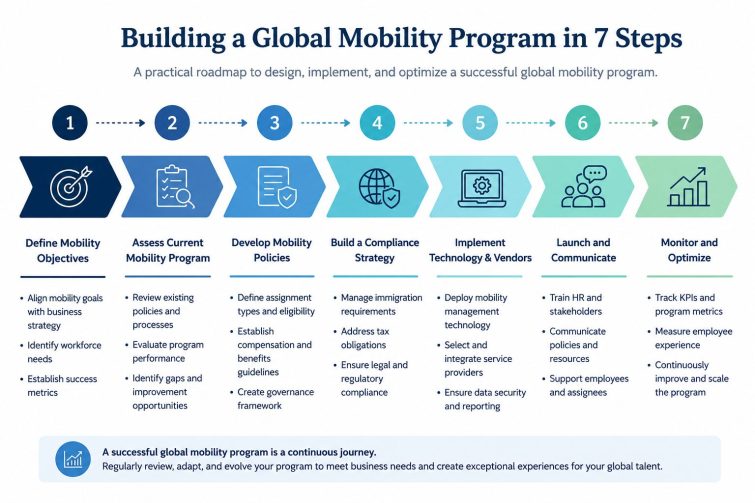
Start with the why. What is the program supposed to do for the business and for talent? Then look honestly at the current state of your program, including the moves you’re already making, what they cost, who handles them, and where the cracks are.
From there, design consistent tiered policies and build out your compliance and tax framework. Choose technology that fits your program’s size and shape and run a pilot before you scale. Executive sponsorship matters more than most people expect—so does aligning with finance, legal, and other business units using the program. Programs trying to launch without those relationships tend to stall out at the first hard conversation.
The Global Mobility Trends Happening in 2026
There are a few shifts are worth keeping an eye on as you r build out your program.
- Remote and hybrid mobility is a new reality, and policies built as exceptions are being formalized as standard offerings.
- Sustainability has turned from a talking point to a standardized metric. Companies now measure the carbon footprint of relocations and take measures to reduce it.
- Geopolitical volatility puts duty-of-care back at the top of the checklist. Security planning is a baseline expectation, not a premium service.
- Analytics is strategic rather than retrospective, helping leaders forecast costs, flag retention risks, and benchmark performance against peers.
Beyond that, borders are going digital faster than most programs can adapt. The EU’s ETIAS system, expanded U.S. travel proclamations affecting 38 countries as of January 2026. The UK’s tightening of migration policy has reshaped what compliance looks like over the past 12 months alone. Meanwhile, the OECD’s November 2025 update on remote-work permanent establishment has put tax exposure back at the top of the mobility risk list.
How CapRelo Supports Global Mobility
CapRelo works with HR and other program leaders to design, run, and improve global mobility programs at every stage. We cover policy consulting, immigration, tax, expense management, and end-to-end relocation services. All of this is backed by the Companion® Client Portal for real-time program visibility.
Whether you’re launching something new, scaling what you have, or rethinking how to handle remote and hybrid arrangements, we bring the people and the infrastructure to make it work.
Global Mobility FAQs
What is global mobility in HR?
In HR, global mobility manages employee moves across international borders. It encompasses policy, immigration, taxes, compensation, and the support services that make international assignments succeed.
Why is global mobility important for companies?
It lets you put talent in the city where you need it. You can develop leaders through international experience and enter new markets with people who already understand your company. A well-made program also protects you from the costs and compliance risks that come with unmanaged moves.
What are the biggest current challenges in global mobility?
Regulatory complexity across jurisdictions, unpredictable costs, and the challenge of retaining assignees after they come home. Each one needs deliberate process and real expertise; none of them solves itself.
What does a global mobility strategy include?
Policy frameworks are tiered by assignment type, immigration and tax compliance, compensation design, employee experience, the right technology, and reporting that connects program performance to business outcomes.
Ready to take a closer look at your global mobility strategy? Get in touch, and we’ll build something that fits your organization.


