Your Step-by-Step Guide to a Stress-Free Work Visa Application

If the thought of applying for your first work visa seems overwhelming, you are not alone. Many employees relocating internationally for the first time get overwhelmed by the process, especially with today’s ever-evolving visa application rules. The three keys we’ve learned through 25 years of international relocation management: preparation, preparation, preparation. Let’s get started.
Gather Required Documents for Your Work Visa Application
The first step in any successful work visa application is understanding exactly which documents are required for your destination country. As with many other aspects of international relocation, the answer varies depending on the host country. But in general, these are the essential documents you’ll need for a smooth visa application:
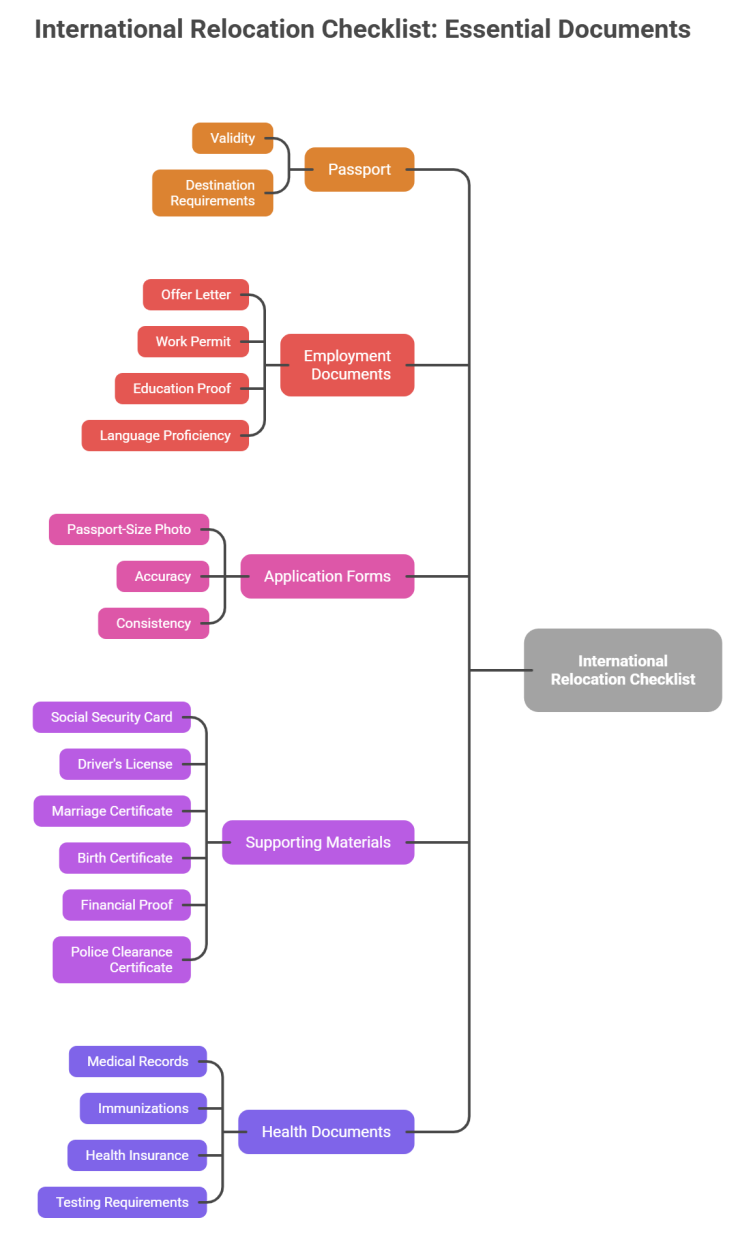
- Passport – Confirm validity. Be sure it meets your destination country’s specific requirements. Many countries require a minimum number of months be remaining on your passport post-travel dates.
- Employment documents – Include your employment offer letter and work permit approval letter and reference number if required for your situation. You may also be asked to show proof of education; note that some countries require this be notarized or apostilled. Some countries also require proof of language proficiency; check your destination’s requirements.
- Application forms – Complete the application form itself. You’ll need a passport-size photo – follow the specific directions. Double-check your forms for accuracy and completeness, and be sure you are consistent on all forms. For example, if you use your maiden name as your middle name on your passport, show it exactly the same way on every reference to your name throughout your documents. Is your street address a lane, road or street? Be sure you show it precisely the same way whenever referenced.
- Supporting materials – These include important documents like Social Security cards and driver’s licenses, and marriage and birth certificates. Expect to show proof of financial means, too. Make copies of bank statements, tax returns and documentation of financial accounts. You’ll also need a police clearance certificate which you can obtain from your local police department; this shows that you have no criminal record. In addition to having hard copies of critical documents, be sure to scan and save them digitally.
- Health documents – Your host country may also have travel health requirements, so pull together your medical records to document you have met all requirements such as immunizations. You’ll also need a medical certificate from your physician documenting a recent health exam as well as proof of health insurance. Some countries also have testing requirements for contagious diseases, and may require shots for localized health concerns like mosquito-borne illnesses.
How to Organize Your Work Visa Application Documents Efficiently
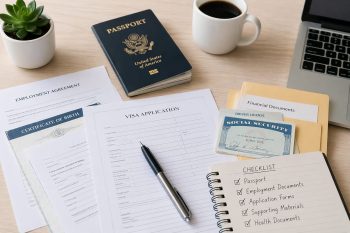
Avoid common mistakes by channeling your inner Type A organized self.
Immerse yourself in the host country’s immigration website. Before even gathering your first document, scroll through the website to get a full picture of the process. You might want to screen shot or print out those pages, or make yourself a hard-copy checklist of what you find. Check items off as you gather them so that once you start the application process, everything you need is at your fingertips.
We advise clients to organize documents in the exact order the website outlines. While it may sound old-school, we suggest setting up a file box to wrangle all your information in one place. Then use labeled folders for each category of documents, to ensure easy access during the submission and actual interview.
How to Prepare for a Work Visa Interview Successfully
Now that you have gathered all your documents, submitted them according to the country’s specifications and paid the required fee, your next step is scheduling your visa interview. As with every other aspect of the process, these steps vary depending on the country to which you are moving.
Let’s say you are relocating to work in Germany from the US. A visit to the German Mission in the US web page is your starting point. From there, you will schedule an appointment using the online appointment system. To determine the right type of appointment and procedure, choose your US state of residence. Still not sure how to proceed? Submit questions to the consulate via the contact form provided.
Regardless of where you are relocating for work, anticipating the work visa interview can be stressful. Reduce that anxiety and approach this important (and exciting) step with confidence by preparing just as you might for a job interview. Anticipate common questions, and practice sincere, thoughtful answers.
For example, some common work visa interview questions if applying for an Australian work visa might be:
- Why are you traveling here and how long do you plan to stay?
- Do you have friends or relatives in Australia?
- Tell us about the job and how did you get this opportunity?
- Do you understand the visa requirements for your stay?
- What are your plans after your work visa expires?
Work Visa Processing Time: How to Plan Your Application Timeline
Traditional work permit processes often involve complex paperwork, long approval times, and regulatory uncertainties. The good news is there is a growing global focus on digitizing the visa application process. As we shared in a recent blog, “Digitalization streamlines these processes by enabling online applications, automated verification, and real-time tracking.” While visa digitalization systems continue to roll out in the European Union and across Asia Pacific, employees should not yet expect the application process to be fully transformed.
How long does the employment visa process usually take? It depends. Timelines can vary dramatically from country to country. In Canada, a work permit can be approved in as little as four weeks while it might take as long as four months in Germany. Additional factors like these can also impact your application timeline:
Below is a general comparison of work visa processing times across popular destinations to help you better plan your relocation timeline:
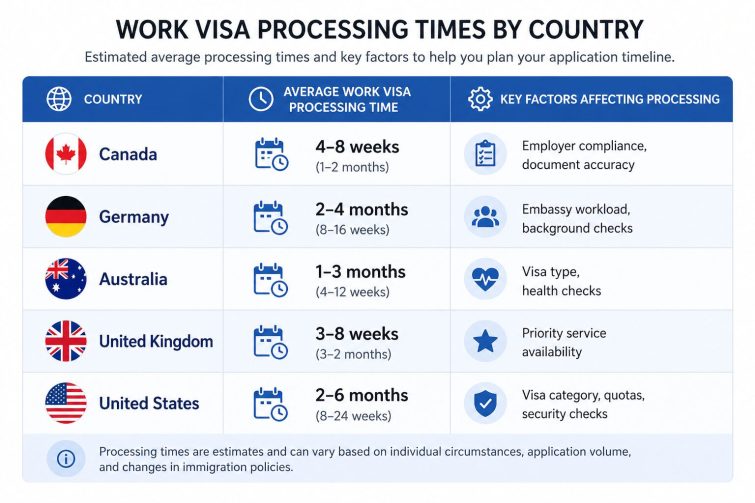 Note: Processing times are approximate and can vary significantly based on visa type, application accuracy, embassy workload, and policy changes.
- Type of work visa applied for
- Employer sponsorship and job offer
- Completeness and accuracy of documents
- Background verification and medical checks
- Embassy or consulate workload
- Peak seasons and policy changes
To be safe, plan for the process to take six months, and be pleasantly surprised if it happens sooner!
What to Do If Your Work Visa Application Is Denied?
In spite of all your best-laid plans, it is possible your work visa application is denied. These are common reasons for denials in Brazil, for example, but likely apply to other countries as well:
- Choosing the wrong type of visa
- Incomplete or incorrect documentation (remember all those documents you were supposed to gather?)
- A poorly structured immigration project or reason for the relocation
- Insufficient financial proof
- Negative immigration or criminal background
- Lack of prior legal analysis.
While a work visa application refusal is frustrating and will delay your relocation, it isn’t final. Make sure you clearly understand the reason for the work visa denial, correct those issues and resubmit your application. Here’s where a seasoned relocation consultant working alongside you really pays dividends.
Our CapRelo team has helped thousands of employees over the past two-plus decades to prepare strong work visa applications, and pivot in the event a denial occurs.
Final Tips for a Successful Work Visa Application
Navigating a work visa application process especially as a first-time transferee or assignee can be complicated and stressful. You can mitigate that anxiety for starting early, staying organized and leveraging CapRelo’s award-winning immigration support resources. Let us help.
Insights + Resources
View all
Relocation Program Reviews, Assignee Wellbeing & Global Mobility Updates. September 2026 Insider

Relocation Mistakes That Cost Up to $1.25 Million

Why the UK Is Still a Top-3 Destination for Global Talent in 2026
