Repayment Agreements After AB 692, State by State

If your company pays to relocate an employee, what happens if they leave a few months later? Can you ask them to pay back the moving expenses, temporary housing, or relocation bonus?
A relocation repayment agreement is meant to answer those questions. It sets out when an employee would have to return some or all of the company’s financial support, usually if they leave before an agreed period ends. You may also hear this called a clawback.
But the agreement is only part of the answer. State laws can limit what employers recover and under what circumstances. And California’s AB 692, including its recent changes, is one important example that could be a harbinger for the future. Understanding those differences can help mobility teams set clearer expectations before a move, and avoid surprises when an employee leaves.
California’s updated rules
AB 692 originally applied to agreements entered into on or after January 1, 2026. However, California’s September 2026 amendment, AB 1697, moved the covered-contract date to January 1, 2027, and made the original provisions inoperative during 2026. Other wage, expense-reimbursement, and contract rules still apply.
The amended law generally prohibits employment terms that make leaving a job trigger a debt, collection activity, or financial penalty, unless an exception applies. It also removes the original requirement that qualifying discretionary monetary payments be made at the outset of employment.
For the general monetary-payment exception, the payment cannot be tied to specific job performance, and all of these conditions must be met:
- Repayment terms appear in a separate agreement.
- Employees receive notice of their right to consult an attorney and at least five business days to obtain advice before signing.
- Repayment is prorated, carries no interest, and uses a retention period no longer than two years from payment.
- Employees can choose to receive the payment after completing the retention period, without a repayment obligation.
- Repayment is triggered only by the employee’s voluntary departure or termination for misconduct.
For relocation programs, counsel should assess whether a particular cash benefit fits this exception. Paying a moving company directly or reimbursing an expense does not automatically qualify simply because the policy calls it a relocation bonus.
Compare the states before reusing an agreement
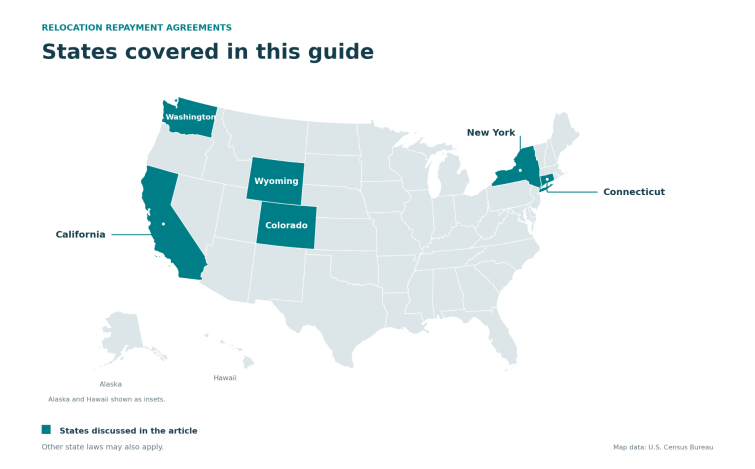
The following snapshot, current as of October 16, 2026, highlights six states with rules relevant to mobility programs. It is an issue-spotting guide, not a complete 50-state enforceability survey.
| State | Timing | What mobility teams should review |
|---|---|---|
| California | Covered agreements from January 1, 2027 | AB 692, as amended by AB 1697, broadly restricts separation-triggered repayment. Identify an applicable exception before drafting a relocation clawback. Separate documentation or proration alone is insufficient. |
| Colorado | Restrictions already in force | C.R.S. § 8-2-113(3)(a) permits recovery of reasonable costs for qualifying training beyond normal on-the-job instruction, with monthly proration over two years after training completion for private employers and compliance with wage law and applicable Attorney General rules. This training exception does not automatically authorize relocation or bonus recovery. |
| Connecticut | Expanded coverage from October 1, 2026 | The employment-promissory-note prohibition now reaches employers of all sizes for newly executed agreements. Section 31-51r retains exceptions, including repayment of sums advanced to employees. Have counsel determine whether a relocation arrangement actually fits an exception. |
| New York | Trapped at Work Act effective December 19, 2026 | Labor Law § 1052 restricts employment promissory notes but expressly excepts certain bonus, relocation, and other non-performance-based benefits. That exception does not cover employees terminated for reasons other than misconduct or employees whose job duties or requirements were misrepresented. |
| Wyoming | Contracts entered into on or after July 1, 2025 | W.S. § 1-23-108, enacted under Wyoming S.F. 107, expressly excepts certain relocation, education, and training repayment provisions from its noncompete ban. Recovery ceilings are 100% before two years of service, 66% from two to under three years, and 33% from three to under four years. These are statutory ceilings, not automatic collection rights. |
| Washington | New rules effective June 30, 2027 | The amended noncompete law reaches repayment or forfeiture imposed because someone pursues a lawful profession, trade, or business. Its education exception requires a written agreement expiring within 18 months of starting employment, proportional repayment, and release for qualifying good-cause separations. Review the actual trigger in relocation and bonus agreements. |
A company’s headquarters does not settle which rules apply. Review where the employee works, where the move takes them, and whether later location changes affect the agreement. An out-of-state governing-law clause should not be treated as a way around mandatory employee protections, such as California’s limits on choice-of-law provisions.
Separate the payments within the relocation package
A relocation package can combine cash, supplier services, training, and immigration support. Those costs should not automatically share one repayment provision.
| Payment type | Practical review question |
|---|---|
| Moving, temporary housing, and travel | Is the benefit a direct supplier payment, an expense reimbursement, or a cash advance? Does applicable law permit recovery of that specific payment? |
| Signing or relocation bonus | Is it a qualifying discretionary payment, or compensation tied to performance? Which notice, deferral, proration, and termination conditions apply? |
| Training or tuition | Is it routine job training or an optional, transferable credential? State exceptions differ in what education qualifies and how much may be recovered. |
| Immigration sponsorship | Which costs must remain with the employer under federal law, and which face additional state restrictions? Keep these expenses separately identified. |
For example, PERM labor-certification rules prohibit employers from seeking repayment from the sponsored worker for the employer’s labor-certification costs, including its related attorney fees. A state-law exception cannot override that restriction. Other immigration expenses need their own fee-specific review.
Keeping these categories distinct also supports more accurate relocation expense management. Teams need to know what was paid, to whom, and for which benefit before calculating any potential repayment.
Test the language against real departures
Consider a $12,000 cash benefit with a 24-month repayment period, assuming counsel has confirmed that the arrangement is lawful in the applicable jurisdiction.
The employee resigns after six months. Under straight-line monthly proration, the unearned portion would be $9,000: $12,000 multiplied by 18 remaining months, divided by 24. The calculation illustrates the schedule; it does not establish that repayment is legally owed.
The employee is laid off after six months. The same calculation may be irrelevant. Under California’s qualifying monetary-payment exception and New York’s relocation-benefit exception, an employer termination for reasons other than misconduct does not support recovery under those exceptions once the relevant rules apply.
The employee is dismissed for poor performance. A policy should not automatically equate missed targets or an unsuccessful role fit with legally defined misconduct. Counsel should assess the actual facts before a repayment demand goes out.
Language such as “repay all costs if employment ends for any reason” deserves particular attention. So do flat exit charges unrelated to recoverable costs and full-repayment requirements that ignore mandatory proration. Renaming a prohibited charge or placing it in a standalone document does not make it enforceable.
Review collection separately from the debt

Even a valid repayment obligation does not automatically authorize a deduction from the employee’s final paycheck. State wage laws can restrict deductions beyond federal minimum-wage and overtime protections. California, for example, prohibits collecting an outstanding employee loan balance through a final-paycheck balloon deduction, even with written consent.
Before collecting, confirm the permitted process, payment deadlines, and treatment of any tax gross-up. The agreement and payroll records should make clear whether a proposed balance reflects cash received, taxes paid, supplier charges, or some combination of those amounts.
Build the review into the mobility process
A useful HR review checklist follows the agreement from the offer through departure:
- Confirm the relevant work locations, agreement dates, and applicable legal exceptions.
- Identify each benefit, its actual cost, and any amounts that cannot be recovered.
- Align the offer letter, relocation policy, repayment agreement, and ongoing communication.
- Document required notice, review time, deferral options, and proration schedules.
- Define permitted repayment triggers and route disputed departures to legal review.
- Confirm payroll, tax, and collection procedures before requesting payment.
That work should support clear communication of relocation benefits before employees commit to a move. Employees need to understand the support available and any lawful conditions attached to it.
CapRelo can help employers align relocation policies, benefit administration, and expense records with their mobility goals, while employment and immigration counsel determine the legal requirements. Contact CapRelo about reviewing your program’s policies and employee communications as repayment rules evolve.
This blog provides general information and is not jurisdiction-specific legal advice.
Insights + Resources
View all
The UK Skilled Worker Visa in 2026: What HR Mobility Teams Need to Know Before They Sponsor

New Federal Housing Law, New Relocation Risks: What Mobility Leaders Need to Watch

California AB 692 and the New Reality for Relocation Benefits
