Employee Relocation Guide: Policies, Packages, and Best Practices

Your VP of Engineering just accepted a position at the new Austin office. Your top sales director is being recruited to lead the London expansion. A promising new hire in Denver needs to be in Charlotte by Q3. Each of these scenarios demands a different level of support—and that’s exactly where a well-designed employee relocation package earns its keep.
This guide covers the building blocks of an effective relocation policy, from tiered benefit structures and relocation cost breakdowns to the management strategies that get employees to say yes.
What Is Workforce Mobility in Employee Relocation?
Employee relocation—often referred to as workforce mobility—is the process of moving someone to a new work location and giving them the support they need to hit the ground running. That support looks different depending on the situation. A senior leader moving internationally with a family of four has vastly different needs than a recent graduate relocating across state lines for a first job.
At its core, the point is always to get the right person to the right place without losing momentum or the person. When using a well-designed relocation assistance package, productivity ramps faster, turnover risk drops, and the employee starts their new role feeling supported rather than stranded.
Employee Relocation Policy: The Tiered Approach
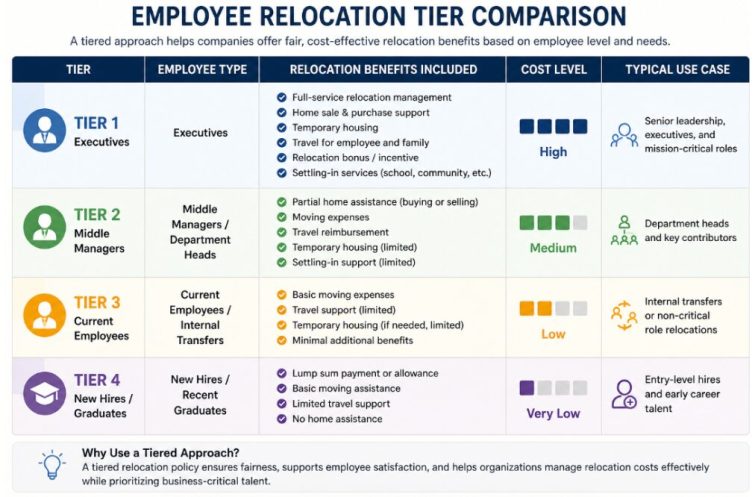 Not every move warrants the same investment, and a tiered relocation policy acknowledges that. Benefits should scale with the employee’s level and the role’s strategic importance. That way, budgets stretch further without leaving anyone under supported.
A common four-tier structure breakdown might look like this:
Tier 1—Executives
An executive relocation package should include full-service relocation management. Home sale and purchase support, temporary housing, family travel, a relocation bonus, and settling-in services such as school research and community orientation, too. These packages carry a high cost, but the investment is justified for senior leadership and mission-critical roles that would be far more expensive to leave unfilled.
Tier 2—Middle Managers and Department Heads
This covers partial home assistance, moving expenses, travel reimbursement, and limited temporary housing and settling-in support. A meaningful package that balances relocation benefits for employees against cost containment.
Tier 3—Current Employees and Internal Transfers
Basic moving expenses, limited travel support, and temporary housing if needed. This is designed for internal transfers and lateral moves where the relocation cost breakdown must stay lean.
Tier 4—New Hires and Recent Graduates
A lump sum payment or allowance, basic moving assistance, and limited travel support. No home assistance provided. Costs are kept to a minimum for entry-level hires and early-career talent.
This kind of employee transfer policy ensures fairness across the organization while giving you the flexibility to invest more heavily where the business impact is greatest. Learn more about structuring these tiers in our guide to developing relocation policies.
Employee Relocation Policy Checklist: Key Benefits and Requirements
Use this checklist to gut-check whether your relocation benefits are competitive:
- Salary adjustments if the new location’s cost of living exceeds the transferee’s current base
- A relocation firm to coordinate logistics and keep stress levels manageable throughout the move
- Loss-on-sale reimbursement for the transferee’s home
- Paid house-hunting trips—ideally two—so the employee and spouse can explore neighborhoods and tour homes before committing
- Home buying assistance from a relocation-savvy real estate agent, along with current mortgage loan resources
- Moving and travel expense reimbursement that covers professional movers and family travel
- Paid time off for house hunting, moving days, and settling in
- Financial assistance for mortgage qualification or down payment support, when feasible
Don’t think of these as just line items. We identified each one because it directly reduces the friction that causes employees to decline offers—or regret accepting them.
The Average Cost of Employee Relocation
 A handful of variables can create a wide range in relocation costs. For domestic moves, a homeowner relocation might run you $60,000–$100,000 or more. That’s once you’ve factored in real estate assistance, household goods shipping, and temporary housing, as well as tax gross-ups. Renter relocations tend to fall in the $20,000 to $35,000 range. International assignments climb much higher—visa processing, tax equalization, cultural training, and cross-border logistics all add more complexity and cost.
This is precisely why tiered policies matter. A flat, one-size-fits-all approach either overspends on junior moves or underserves the senior ones. Neither outcome is good for retention.
Common Employee Relocation Challenges
Even well-funded programs can encounter friction. Offers are declined because of a spouse’s career, a child’s school year, or leaving a community behind. Real estate timelines fall out of sync with start dates. Tax implications get underestimated, especially in global mobility programs spanning multiple jurisdictions. And cultural adjustment (easy to overlook during planning) can quietly derail an otherwise successful move.
A bigger budget is not the most effective mitigation. Your employees want clear communication, dedicated support from people who’ve managed hundreds of these transitions, and policy flexibility that lets you adapt to individual circumstances.
Some Employee Relocation Trends in 2026
The difficulties inherent in relocation have changed considerably. Hybrid and remote work policies affect which moves get approved and how packages are structured. Consequently, some roles that once required a full relocation now only need occasional travel to work. Cost-of-living adjustments face greater scrutiny as economic conditions become more unpredictable. And duty-of-care expectations are rising across the board, with companies held to a higher standard for the health, safety, and well-being of relocated employees and their families.
Technology will play a bigger and bigger role. Successful relocation will require platforms that give HR teams real-time visibility into the data they need. That info includes program spend, transferee milestones, and policy compliance. The programs performing best in 2026 will treat relocation as a strategic investment. Don’t treat it as another administrative task if you want to stay ahead of the game.
Employee Relocation Management Tips to Improve Acceptance Rates
A strong corporate relocation services package only works if employees accept the offer. And acceptance starts well before you slide a benefits summary across the table.
Listening is the most important. When you raise relocation as a topic, the employee’s initial concerns—about a partner’s job, aging parents, or a teenager who doesn’t want to switch schools—deserve to be heard before the conversation turns to perks. That’s where you build trust, and it’s also where you’ll learn whether the candidate’s genuinely a fit for the move.
Beyond the fundamentals, consider equity or stock options as an incentive for senior or high-potential employees. A pay raise or adjustment calibrated to the new location’s cost of living is another strong factor. They may not realize that a move from Boston to a market like Tulsa can mean the same paycheck goes a whole lot further. Your employees need to hear the details of that story clearly, or hearing just the salary number might scare them off.
Above all, be positive about the opportunity. Enthusiasm’s contagious, and it’s noticed when it’s absent.
Frequently Asked Questions
What is employee relocation?
Employee relocation is the process of moving a new or current employee to a different work location, supported by financial assistance, logistical coordination, and benefits designed to ease the transition.
What does a typical relocation package include?
A typical employee relocation package may include moving expense reimbursement, temporary housing, home sale and purchase assistance, travel costs, salary adjustments, and settling-in support. What’s offered depends on the company’s policy and the employee’s tier.
How much does employee relocation cost?
It varies depending on its scope. Domestic homeowner relocations commonly range from $60,000 to $100,000, while renter moves are typically $20,000 to $35,000. International relocations can cost significantly more depending on the destination, family size, and program complexity.
What is a tiered relocation policy?
A tiered policy assigns different benefit levels based on an employee’s seniority or role. Benefits are scaled so the organization can offer competitive support while keeping overall program costs in check.
How do you manage employee relocation effectively?
Start with a clear, well-communicated policy. Partner with an experienced relocation services provider, use technology to track compliance and milestones, and prioritize the employee experience at every stage. The programs that retain the most talent are the ones where employees feel guided, not processed.
Insights + Resources
View all
The UK Skilled Worker Visa in 2026: What HR Mobility Teams Need to Know Before They Sponsor

New Federal Housing Law, New Relocation Risks: What Mobility Leaders Need to Watch

California AB 692 and the New Reality for Relocation Benefits
