What Is Relocation Assistance? Benefits, Costs & How It Works

Relocation assistance is the support an employer provides to help an employee move for a job, from financial reimbursement to fully managed programs that coordinate every step of the transition. It’s a discretionary benefit, not a legal requirement, and it can range from a single lump-sum payment to a comprehensive package covering housing, travel, and settling-in support.
Here’s the moment this guide is written for: the offer letter arrives, and somewhere below the salary line it says “relocation assistance provided.” For the candidate, that phrase could mean a check — or it could mean a coordinated program that handles everything from the household goods shipment to finding a new school district. For the HR mobility leader who wrote the policy, the challenge is the same in reverse: making sure “relocation assistance” means something specific, fair, and competitive.
This guide breaks down what relocation assistance actually is, how it works, who qualifies, and the forms it takes — so both HR teams and transferees know exactly what to expect.
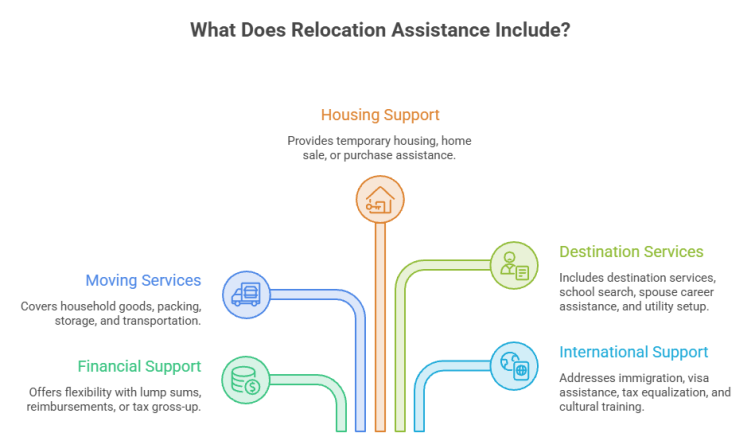
The diagram below highlights the five core components most commonly included in a relocation assistance program. While every employer’s policy is different, these categories form the foundation of most corporate relocation programs.
What Is Relocation Assistance and How Does It Work?
Relocation assistance is the umbrella term for the support an employer provides to help an employee move for a job — whether that’s a new hire relocating to headquarters, a current employee accepting an internal transfer, or an executive taking on an international assignment.
At its core, relocation assistance exists to remove friction from a required move. The employer identifies that a role needs to be filled in a specific location, and rather than leaving the employee to shoulder the full financial and logistical burden alone, the company offers some combination of funds, services, and guidance to make the transition smoother.
How it works in practice depends on the employer. A small business might offer a flat reimbursement toward the move. A large enterprise, by contrast, typically partners with a relocation management company (RMC) to coordinate household goods transportation, temporary housing, and real estate support — all under a documented relocation policy that spells out what’s covered at each employee level.
Relocation Assistance vs. a Relocation Package: What’s the Difference?
Relocation assistance is the broad concept — the fact that an employer provides support for a move in some form. A relocation package is the specific, itemized bundle of benefits, dollar amounts, and services an individual transferee actually receives.
Think of it this way: relocation assistance is the policy; the relocation package is the paycheck. A company’s relocation assistance program might include lump-sum options, managed relocation services, home sale support, and destination services. The relocation package is what results when those options are applied to one transferee’s specific move, tier, and circumstances.
If you’re trying to understand what a relocation package typically costs and includes at different employee levels, our guide on relocation package costs and benchmarks breaks that down in detail. This article focuses on the bigger picture: how relocation assistance works as a program, who it’s for, and the types of support available.
Who Qualifies for Employer Relocation Assistance?
There’s no universal rule, because relocation assistance is a discretionary benefit rather than a legal requirement. That said, a few qualifying scenarios show up across most organizations:
- New hires relocating from outside the local commuting area to accept a job offer
- Internal transfers, including promotions or lateral moves to a different office or region
- International assignees, whether on a short-term assignment or a permanent transfer
- Government and specialized roles, which may follow federally mandated relocation allowances
Eligibility is typically defined in a company’s written relocation policy, often tied to job level, distance of the move (commonly a 50-mile minimum), and whether the move is voluntary or employer-initiated.
Best Practice: Transferees should always ask HR for the specific policy that applies to their role rather than assuming a “standard” package exists — because it usually doesn’t.
What Does a Typical Relocation Assistance Program Include?
A typical relocation assistance program combines several categories of support, mixed and matched to the transferee’s needs and the company’s budget:
- Household goods transportation — professional coordination of packing, shipment, and delivery of belongings, plus short-term storage
- Temporary housing — corporate housing or short-term rentals while the transferee finalizes permanent housing
- Home sale and home purchase assistance — real estate support and, in some cases, tax-protected buyout programs
- House-hunting trips — funded visits to the new location before the move
- Travel reimbursement — mileage, airfare, and lodging during the move itself
- Destination services — help finding schools, setting up utilities, and getting oriented in a new city or country
- Spousal or partner career support — resume help or job search assistance for a relocating partner
- Miscellaneous allowances — funds for smaller costs like driver’s license changes or minor furnishings
For a deeper look at how these benefits typically scale by employee level, our employee relocation guide walks through a common four-tier structure used across corporate mobility programs.
Domestic vs. International Relocation Assistance
The scope of relocation assistance changes significantly depending on whether a move crosses state lines or a border.
Domestic relocation assistance generally centers on household goods transportation, temporary housing, travel, and — for homeowners — real estate support. CapRelo’s U.S. domestic relocation services are built around this kind of coast-to-coast move.
International relocation assistance adds visa and immigration support, tax equalization, cultural and language training, and a longer runway for house-hunting and settling in. That makes international assignments typically more comprehensive — and more expensive — than domestic relocations. See how CapRelo’s global mobility management services are structured to handle that added complexity, backed by 25+ years of experience across the Americas, EMEA, and Asia Pacific.
Lump Sum, Managed, and Core-Flex: The Main Delivery Models
Beyond what’s covered, how relocation assistance is delivered matters just as much. There are three main models:
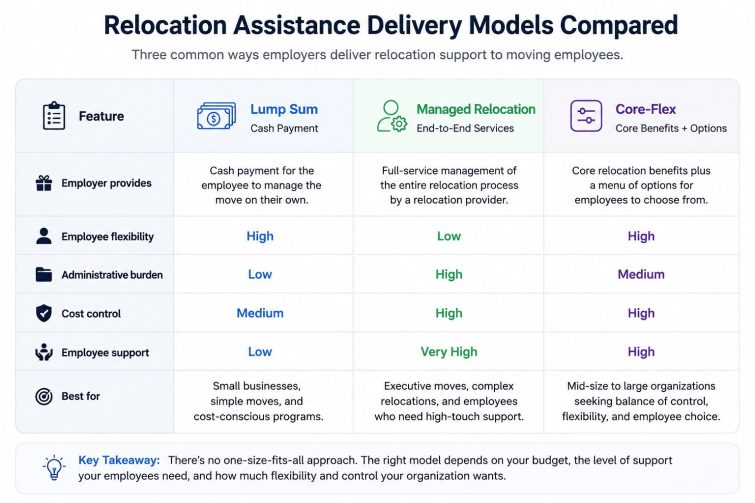
- Lump sum — a single cash payment the transferee manages independently. Simple to administer, but it shifts all the planning and supplier coordination onto the employee, often during one of the most stressful periods of their life.
- Fully managed — an RMC coordinates every step, from household goods to real estate to expense tracking, typically reserved for higher-tier or more complex moves.
- Core-flex — a set of core benefits everyone receives, paired with optional services each transferee selects based on their own needs. This model has grown steadily as companies look to balance cost control with flexibility.
Best Practice: Core-flex works best when transferees can actually see and choose their options. CapRelo’s CompanionFlex portal gives transferees a shopping-cart-style menu of approved benefits — personalized to their tier — while giving HR reportable usage data to refine the program over time. One policy that works for everyone, because one size never fits all.
Does Relocation Assistance Have to Be Repaid If You Leave Your Job?
Often, yes. Many companies attach a repayment or “clawback” clause to relocation assistance, requiring the employee to repay some or all of the benefit if they leave voluntarily within a set period — commonly 12 to 24 months after the move.
The specifics vary widely by employer, so review the relocation agreement closely before accepting an offer — particularly the repayment terms and how they’re prorated over time.
Are Relocation Benefits Taxable for Employees?
Yes — and this is one of the most misunderstood parts of relocation assistance. Since the Tax Cuts and Jobs Act of 2017, employer-paid relocation costs have generally been treated as taxable income for most civilian employees under the IRS moving expense deduction rules.
2026 Update: That treatment is now permanent. Under the One Big Beautiful Bill Act, the exclusion for qualified moving expense reimbursements has been permanently eliminated for most workers, with continued exceptions for active-duty military members relocating under a permanent change of station and, newly, employees or appointees within the U.S. intelligence community.
In practical terms, a relocation payment or reimbursement is generally added to the employee’s W-2 wages and subject to federal income tax withholding, Social Security, and Medicare taxes. To offset this, many employers provide a tax gross-up — an additional payment calculated to cover the transferee’s added tax liability.
Best Practice: Treat gross-up as a standard part of the conversation, not an afterthought, when structuring or evaluating a package. Nothing sours a relocation faster than a surprise on the transferee’s first post-move paycheck.
(This is general information, not tax advice — consult a qualified tax professional about your specific situation.)
How Do Companies Calculate Relocation Assistance?
Most organizations calculate relocation assistance using a combination of four factors:
- Employee tier or level — the single biggest cost driver, since senior roles typically warrant more comprehensive support
- Homeowner vs. renter status — home sale assistance adds significant cost that renter moves don’t require
- Distance and move complexity — cross-country and international moves cost substantially more than regional ones
- Industry benchmarking data — many companies work with an RMC or consult third-party benchmarking studies to keep offers competitive without overspending
Can Relocation Assistance Be Negotiated During a Job Offer?
In many cases, yes — particularly for hard-to-fill roles, senior positions, or moves from high cost-of-living areas. If a standard package feels light relative to what the move will actually require, it’s reasonable to ask about flexibility around temporary housing duration, home sale support, or lump-sum size.
Employers with a documented, tiered policy typically have less room to negotiate than those making decisions ad hoc — which is itself a good argument for building a clear policy in the first place.
Best Practices for Creating a Relocation Assistance Policy
For HR and mobility leaders building or refining a program, a few principles separate strong policies from problematic ones:
- Tier benefits by role and complexity rather than offering one flat package.
- Document everything in writing — eligibility, covered expenses, repayment terms, and the exception process.
- Address tax gross-up explicitly so transferees aren’t surprised by the hit to their take-home pay.
- Build in flexibility through core-flex options where possible, so each transferee gets support that fits their actual move.
- Support the transferee around the clock. Questions don’t keep business hours. CapRelo’s Moxie, an AI-powered relocation assistant, fields 25–50 questions per move — generating up to 6,600 hours of annual operational efficiency across our client base while transferees get answers whenever they need them.
- Partner with an RMC once volume or complexity outgrows what an internal team can manage efficiently.
Frequently Asked Questions
What is relocation assistance?
Relocation assistance is the support an employer provides to help an employee move for a job. It can include financial reimbursement, household goods transportation, temporary housing, real estate support, and destination services — delivered as a lump sum, a fully managed program, or a core-flex model.
Is relocation assistance the same as a relocation package?
No. Relocation assistance is the overall program of support an employer offers; a relocation package is the specific set of benefits, dollar amounts, and services one employee receives under that program, based on their tier, move type, and circumstances.
Is relocation assistance taxable?
Yes, for most civilian employees. Employer-paid relocation costs are treated as taxable W-2 income, a rule made permanent under the One Big Beautiful Bill Act, with exceptions for active-duty military and U.S. intelligence community personnel. Many employers offset the liability with a tax gross-up payment.
Do you have to pay back relocation assistance if you quit?
Often, yes. Many employers include a clawback clause requiring repayment of some or all relocation benefits if the employee leaves voluntarily within a set window, commonly 12 to 24 months. Review the relocation agreement’s repayment and proration terms before accepting an offer.
Can you negotiate relocation assistance?
Frequently, yes — especially for hard-to-fill or senior roles and moves from high cost-of-living areas. Common negotiation points include temporary housing duration, home sale support, and lump-sum size. Companies with documented, tiered policies tend to have less flexibility than those deciding case by case.
Getting Relocation Assistance Right
Relocation assistance works best when it’s treated as a program, not a one-off favor — with clear eligibility rules, defined benefits, and a plan for the details that trip most companies up, like taxes and repayment terms. Whether you’re comparing job offers or building a policy from the ground up, understanding how the pieces fit together is the first step toward a move that actually goes smoothly.
If you’re an HR or mobility leader looking to build or refine a relocation assistance program, talk to a relocation consultant about designing a policy that fits your workforce and your budget.


